Fourteen business strategy frameworks, grouped by the job they do - positioning, analysis, customer value, the creative brief, diagnosis, and goals - with an honest note on when each one earns its keep.
Strategy has a branding problem. The word is so swollen with offsite retreats and 40-slide decks that people forget what it means: choosing what to do, and - the painful half - what not to do. Everything else is a nicely formatted to-do list with ambition.
The frameworks below don't make the choice for you. They do something more useful: they force the choice into the open, where you can argue about it before you spend the budget. A good framework is a place to have the fight on paper instead of in market.
Here are fourteen of them from our library, grouped by the job they actually do. Use the right one for the right call, and ignore the rest until they're needed.
Where to play: positioning and the brave no
The first question is never "how do we grow". It's "where do we even compete, and what are we willing to skip". That second clause is where most strategies quietly die.
Playing to Win is the cleanest version of this. Lafley and Martin chain five linked choices - from your winning aspiration down to the capabilities and systems that make it real - so a vague "be the best" turns into a sequence you can pressure-test. It's brilliant for a leadership team that keeps confusing aspiration with strategy. It's overkill for picking next quarter's campaign.
If your market feels like a knife fight in a phone booth, look at Blue Ocean Strategy. The ERRC grid - Eliminate, Reduce, Raise, Create - pushes you to stop matching rivals feature-for-feature and instead change what the category competes on. Be honest, though: blue oceans are rarer than the book sells, and the case studies are gloriously cherry-picked. Treat it as a lens, not a guarantee.
For growth direction specifically, the Ansoff Matrix is the fastest sketch on the board: existing or new product, existing or new market. Four boxes, four bets, rising risk as you move away from the corner you already own. And when you're juggling a whole portfolio rather than one bet, the BCG Matrix sorts products into Stars, Question Marks, Cash Cows and Dogs by growth and share. Useful for spotting what to fund and what to quietly euthanise - just remember share is a proxy for profit, not the same thing, which is precisely how it wrecks people.
The analysis tools: 2x2s and the five-force squeeze
Then there are the workhorses. The ones everyone has heard of, which is exactly why they get abused.
SWOT Analysis is the most famous and the most wasted. A wall of bullet points is not a strategy; it's a brainstorm that ran out of steam. The value is in pairing the cells - using a Strength against an Opportunity, defending a Weakness against a Threat. If you stop at four lists, you stopped too early.
The Eisenhower Matrix isn't strategy so much as triage - urgent versus important, sorted into Do, Schedule, Delegate, Delete. But strategy lives or dies in Quadrant 2, the important-not-urgent work nobody screams about until it's a crisis. Defend that quadrant.
And when the real question is "why is this industry so hard to make money in", reach for Porter's Five Forces. New entrants, suppliers, buyers, substitutes, rivalry - it explains why your margins are thin even when your product is good. It's an industry x-ray, not a campaign tool. Don't ask it about your tagline.
A framework is not a strategy. It's a question, formatted well enough that you can't dodge it.
Customer value: what you actually offer, and how it all hangs together
Strategy that ignores the customer is just internal opinion with a budget. Two tools keep you honest here.
The Value Proposition Canvas maps customer jobs, pains and gains against your products, pain relievers and gain creators - and the magic is in the fit. If your gain creators answer pains nobody actually has, you've found your problem before launch instead of after. Zoom out one level and the Business Model Canvas puts the whole machine on one page: nine blocks covering how you create, deliver and capture value. It's the fastest way to see whether a clever idea has a business attached or just a vibe.
The brief: turning strategy into something a team can build
Here's where strategy meets the people who have to make the thing. A choice that can't be briefed is a choice that won't happen.
Get Who To By compresses a whole brief into one sentence: GET this objective, from WHO, TO do this behaviour, BY this lever. If you can't finish the line, you don't have a brief yet - you have a hope. The 4C Strategy Model finds the sweet spot where Company, Category, Customer and Culture overlap, which is the account planner's quiet superpower: an idea that's true for the brand and the market and the moment, all at once.
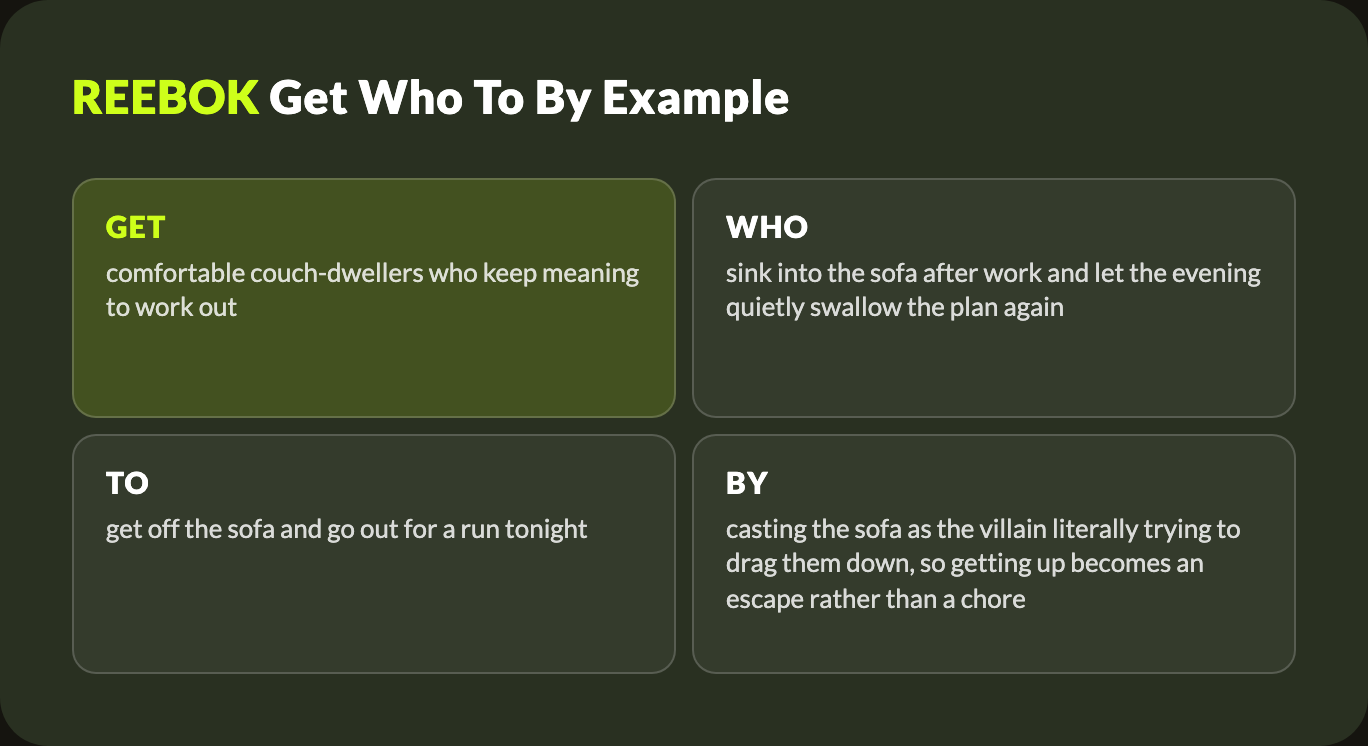
Get Who To By: Reebok - see the full breakdown
Watch: Reebok: Escape the Sofa - see it in our campaigns library
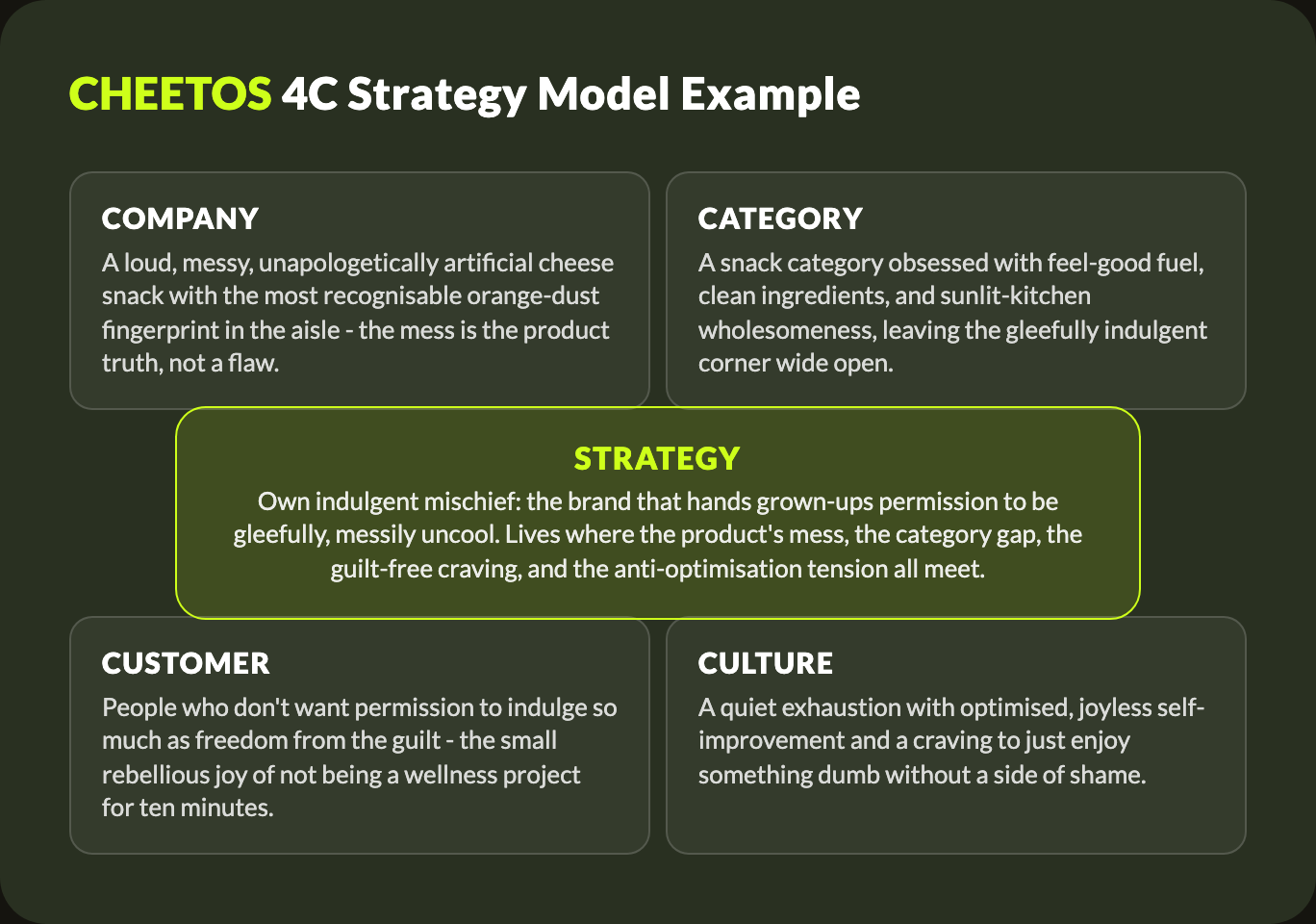
4C Strategy Model: Cheetos - see the full breakdown
Watch: Cheetos: It Wasn’t Me - see it in our campaigns library
Then there's the 4 Points Strategy from Mark Pollard, which lays Problem, Insight, Advantage and Strategy across one diamond. It's the bridge between a business goal and a brief sharp enough to cut. The diagram below shows a 4 Points Strategy worked all the way through on a real campaign - Burger King's Whopper Detour, the one that bribed people to drive to a McDonald's before redirecting them.
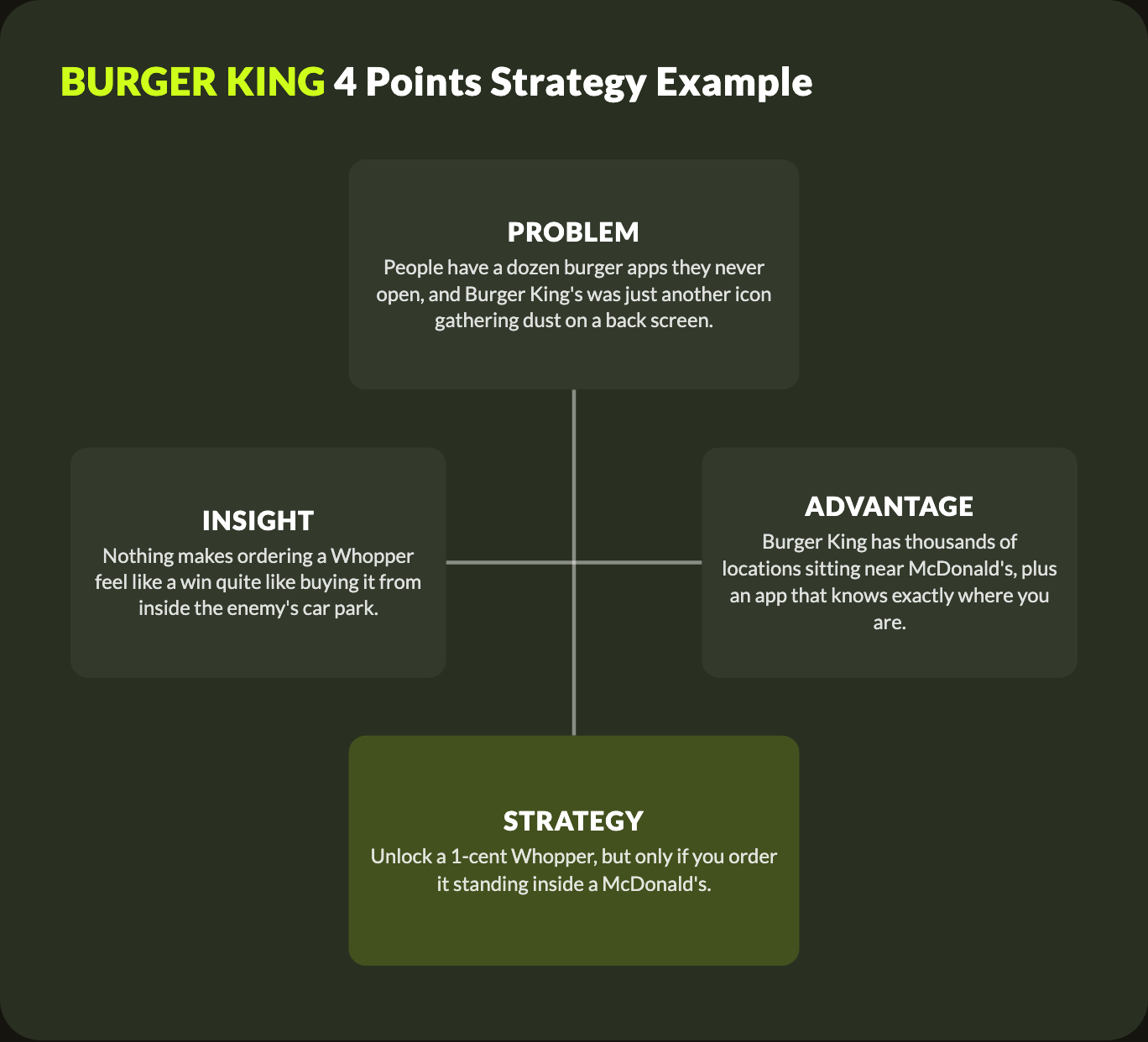
4 Points Strategy: Burger King - see the full breakdown
Watch: Burger King: Whopper Detour - see it in our campaigns library
Diagnosis and goals: find the real problem, then commit
Before you solve anything, make sure you're solving the right thing. The 5 Whys is Toyota's deceptively dumb-looking root-cause tool: ask "why" five times and you tend to walk past the symptom into the cause you can actually fix. Churn isn't "people leave"; five whys later it's a broken onboarding email. Cheap, fast, occasionally humbling.
And once you know where to play and what to fix, you need everyone pulling the same direction. OKRs - one ambitious Objective, a few measurable Key Results - are how Grove and Doerr turned vague intent into something you can score on a Friday. The trap is obvious and everywhere: writing Key Results you're certain you'll hit. That's not a goal, that's a status update wearing a costume.
Pick the call, not the collection
You don't need all fourteen. You need the one that fits the decision in front of you - and the discipline to actually choose, not just fill in boxes and feel productive.
The trick good strategists know is that the framework is scaffolding. You build the strategy inside it, then take the scaffolding down. Nobody should be able to see the SWOT in the finished work.
Want the live diagrams, worked examples on real brands and the honest sources behind each one? They're all waiting in the frameworks library. Pick the call you're stuck on and start there.