Most audience work describes people instead of understanding them. These six frameworks - Jobs To Be Done, Bullseye Customer, Empathy Map, Customer Persona, Customer Journey Map, and the Insight & Tension Statement - get you to the human truth that unlocks the idea.
Here's an uncomfortable truth about most audience work: it describes people without understanding them. You end up with a slide that says "Sarah, 34, urban professional, loves brunch and self-care" and you've learned precisely nothing about why she'd ever pick you over the seven other options sitting in her search results.
The Audience & Insight category exists to fix exactly this. It's the set of frameworks for understanding the human on the other side of your work - not their age bracket, but what job they're hiring you for, how they feel about it, where they are in their day, and the one true insight that turns a bored shrug into a sale.
There are six tools in here, and they each answer a different question about the same person. Let's walk them.
Start with the job, not the customer
The most useful reframe in the whole category is Jobs To Be Done. The premise: people don't buy products, they hire them to make progress in a specific situation. Nobody wants a quarter-inch drill. They want a quarter-inch hole. Actually, they want the shelf up so their partner stops mentioning the shelf.
What makes Jobs To Be Done genuinely good is that it explains why people don't switch as well as why they do. Two forces push you toward something new (the pain of your current situation, the pull of the new option) and two forces drag you back (anxiety about the new thing, and the sheer gravity of habit). An idea only lands when push and pull beat anxiety and habit.
The diagram below maps those four forces of Jobs To Be Done on a real worked example, so you can see why a perfectly good product still loses to "eh, what I've got is fine."
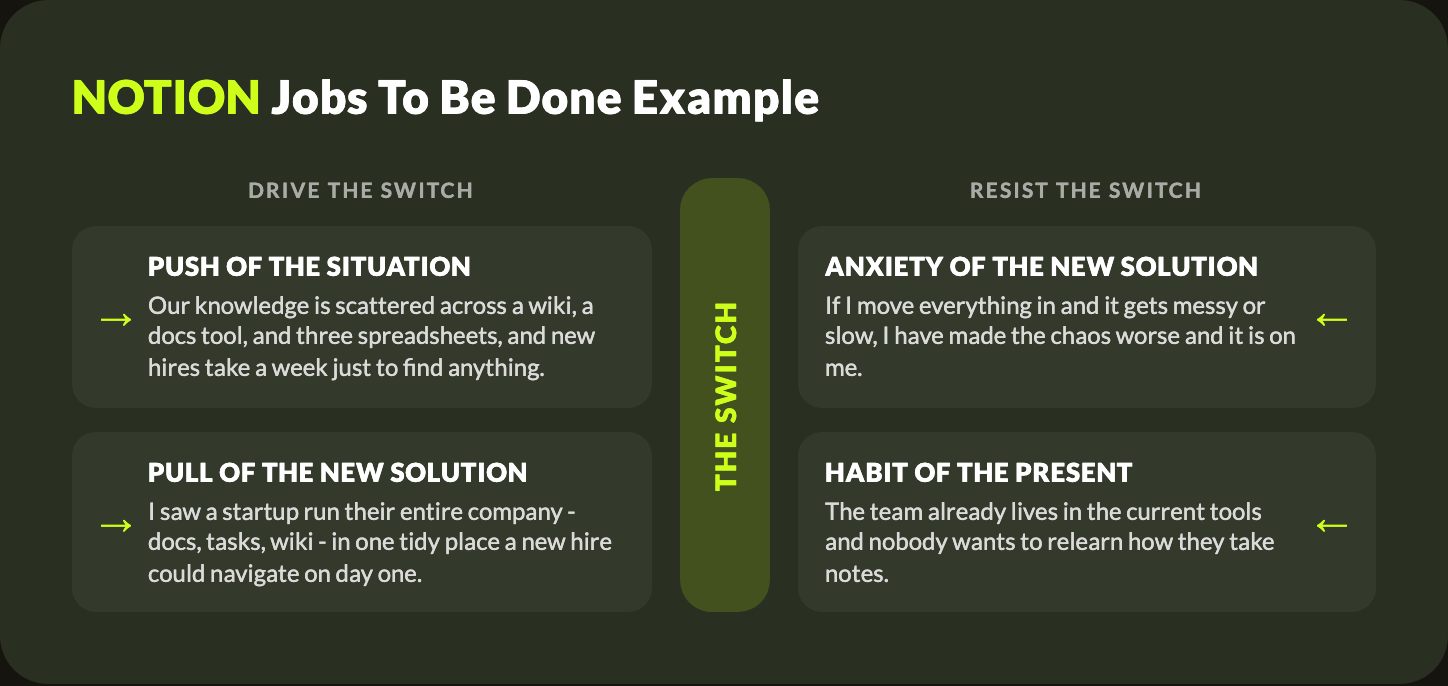
Jobs To Be Done: Notion - see the full breakdown
Then decide who you're actually for
Once you understand the job, you have to decide whose job. This is where most brands flinch, because picking a sharp audience feels like turning away revenue. It isn't.
The Bullseye Customer framework gives you permission to aim. You find the sharpest core segment - the people who feel the job most acutely and have the fewest reasons to say no - and you win them completely before expanding to the adjacent and broader rings. It's beachhead logic. You don't invade the whole coastline at once; you take one beach and earn the rest. Brands that try to be for everyone on day one tend to be memorable to no one.
If your audience definition would fit on a billboard without anyone disagreeing, it's not an audience. It's a census.
Get inside their head
Now that you know who, you need to know what it's actually like to be them. Two frameworks handle this, and they're often confused, so here's the honest difference.
The Empathy Map is the fast one. Four quadrants - what your customer Says, Thinks, Does, and Feels - built from real research, not vibes. Its quiet superpower is exposing the gap between Says and Does, which is where most insight lives. People say they want healthy food and do buy the crisps. The gap is the brief.
The Customer Persona is the deeper one - a research-based archetype with goals, frustrations, motivations, and the channels where they actually hang out. And this is where we need to have a word about the lazy version. A persona built from stock-photo demographics ("Marketing Mary, 42, enjoys yoga and ROI") is worse than useless, because it gives the room false confidence. It feels like research while being a horoscope. A real persona is grounded in things people actually said and did. If you can't trace a line on the persona back to an interview or a behaviour, delete it.
Watch them move through time
People aren't static, and neither is their relationship with you. The Customer Journey Map plots what they do, think, and feel across the whole arc - from the first "who are these people" to the eventual "I tell everyone about these people." Five stages, awareness to advocacy.
What it's really for is finding the moments that matter. Almost every journey has one or two specific points where people quietly leak away, and they're rarely the ones you'd guess. You can't fix a friction you haven't located, and a good journey map locates it.
Land on the one true thing
All of the above is research. Research isn't an insight. An insight is research that's been compressed until it becomes uncomfortable.
The Insight & Tension Statement is the framework that does the compressing. It stacks an observation, a tension, and an insight into one brief-ready human truth. The tension is the load-bearing part - the contradiction the person is living with, the thing they want and the thing that stops them, both true at once. "I want to do the right thing for the planet, but I also don't want to look like I'm trying too hard." That tension is worth more than a hundred bullet points about sustainability attitudes, because it tells you what to actually say.
Used together, these six don't describe an audience - they move you from a person to a job, to a segment, to a feeling, to a friction, and finally to the single sentence an idea can hang on. That's the point of the category: understanding deep enough that the creative work almost briefs itself.
Every one of these comes with a live diagram, worked examples on real brands, and honest sources, including the bits where the framework lies. Pick the question you're stuck on and start there - browse the full Frameworks library and put one to work on the human you're actually trying to reach.