Strategy that nobody can repeat is just an expensive secret. These four messaging frameworks - Venn Diagram, Idea Cascade, Pyramid of Truth, and Message Map - take a clever strategy and turn it into one line a stranger could say back to you.
Here is a quiet little tragedy of our trade. A team spends six weeks building a strategy so airtight it could survive a board review, an audit, and a hostile in-law. Then someone asks, "So what are we actually saying?" and the room goes the specific kind of silent that a fridge hum can fill.
That gap - between a strategy you can defend and a message a stranger can repeat - is exactly what this category is for. Messaging & Communication frameworks take the clever thing you decided in a room nobody else was in and turn it into something worth saying out loud. One sharp message, cascaded into work that cuts through.
Strategy is the thinking. Messaging is the saying. They are not the same job, and pretending they are is how you end up with a 40-slide deck and a tagline that means nothing.
The two halves of the messaging problem
Messaging work is really two questions wearing the same coat. First: what is the one thing we should say? Second: how do we say it so it survives contact with the real world - across formats, across channels, across an audience that does not all want the same thing?
The four frameworks here split neatly along that seam. Two of them help you find the message. One helps you cascade a single idea into many executions. One helps you translate one message across different people. Use the wrong one for the wrong job and you will feel the friction immediately, like trying to open a wine bottle with a screwdriver. Deeply unwise.
Finding the message
Start with the Venn Diagram. It is the most honest tool in the set because it refuses to let you say something only you care about. You draw two circles: what your brand can genuinely own, and what your audience actually cares about. The message lives in the overlap, and nowhere else. The part of your brand truth that nobody wants is a hobby. The part of audience desire you can't credibly claim is somebody else's ad.
The diagram below shows the Venn Diagram worked through on a real brand, so you can see what "the overlap" looks like when it stops being a metaphor.
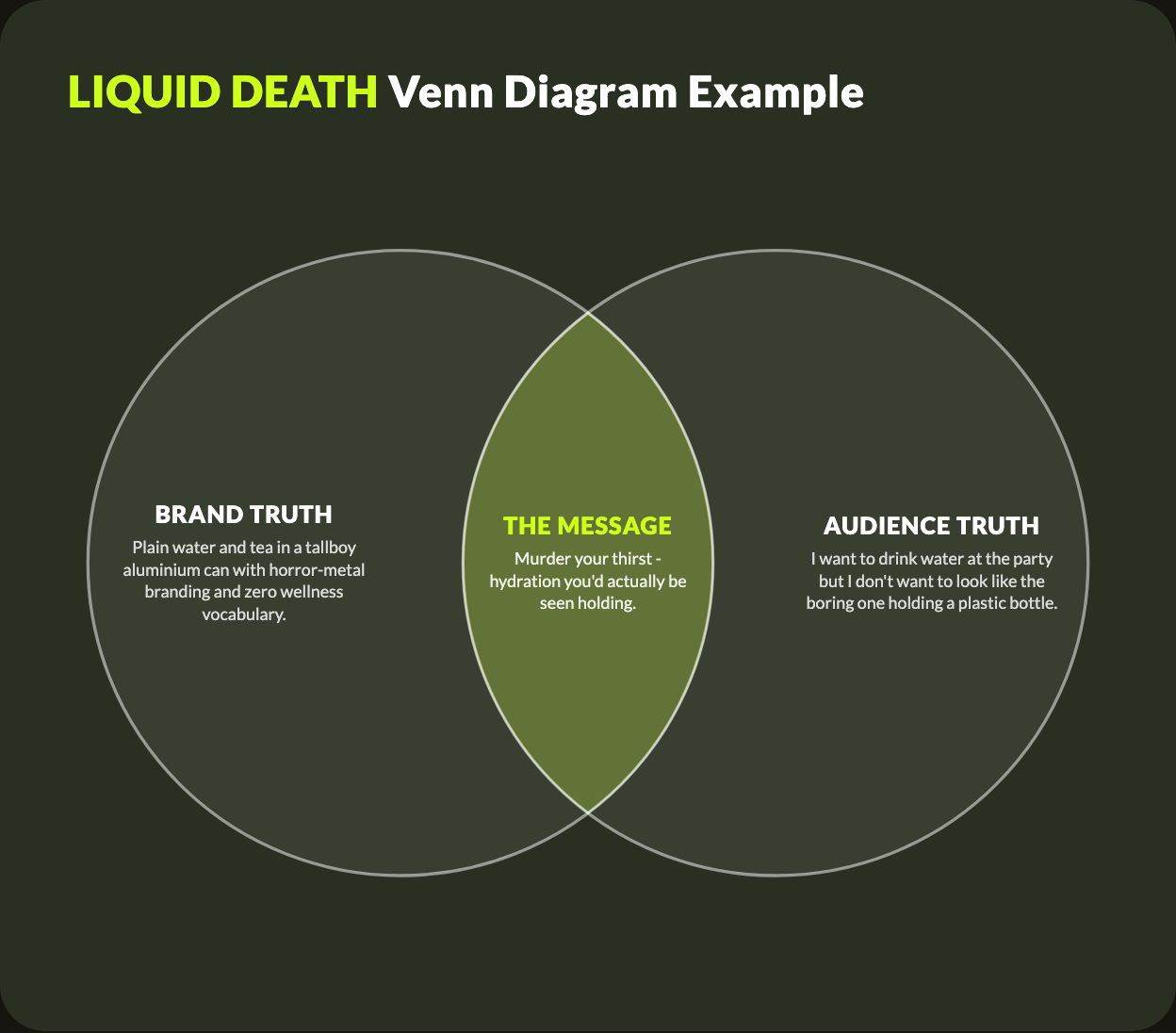
Venn Diagram: Liquid Death - see the full breakdown
Watch: Liquid Death: Kegs For Pregs - see it in our campaigns library
The Pyramid of Truth plays a similar game with a sharper edge. Instead of two circles it triangulates three: brand truth, human truth, and cultural truth. Where all three meet, you get a core idea that feels both true to you and true to the moment. It is the difference between a message that is correct and a message that is alive. Correct messages get approved. Alive ones get repeated.
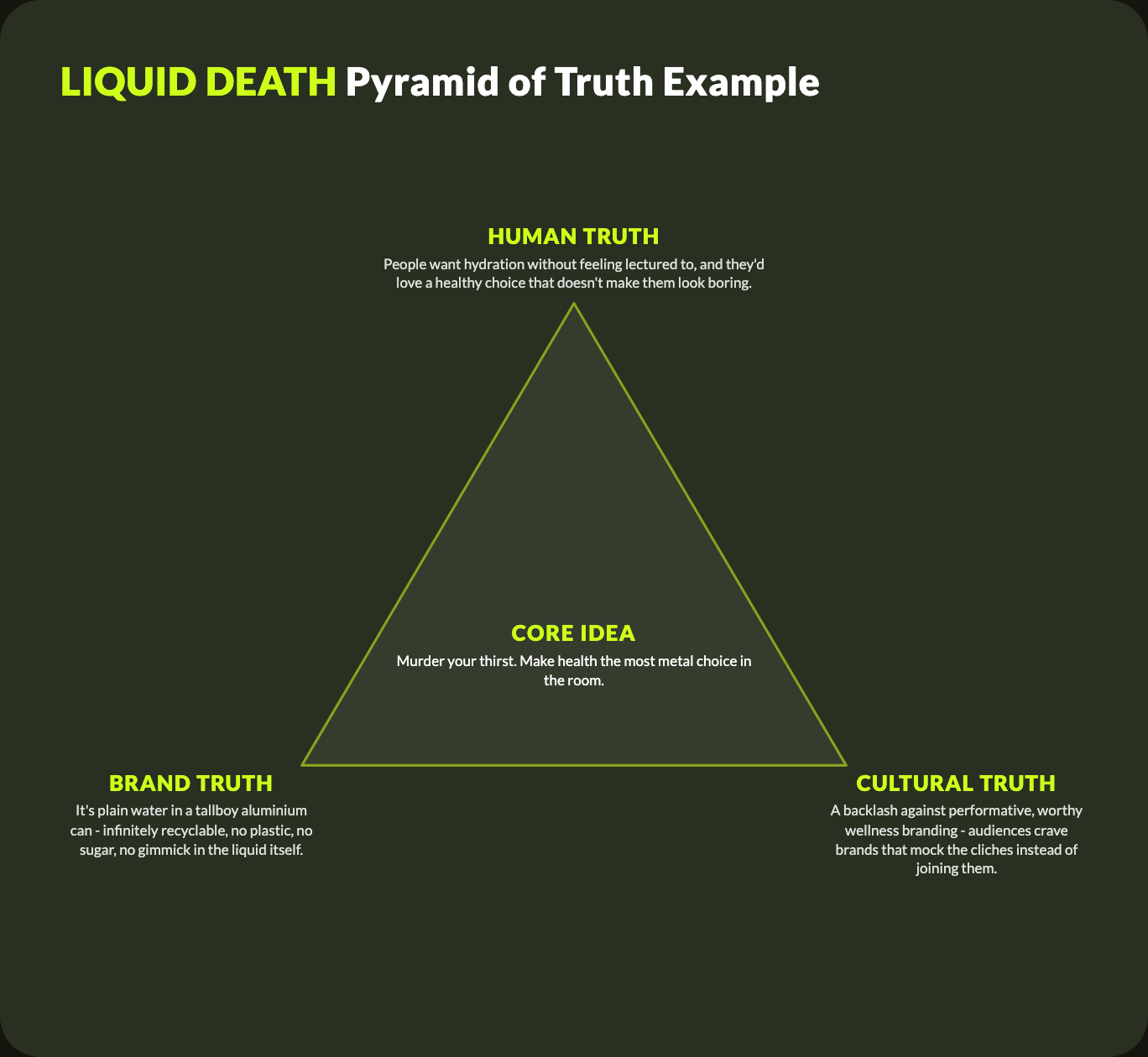
Pyramid of Truth: Liquid Death - see the full breakdown
Watch: Liquid Death: Deadliest Stuff On Earth? - see it in our campaigns library
A message you can defend in a meeting and a message a fourteen-year-old would text to a friend are rarely the same sentence. The frameworks exist to drag them closer together.
Cascading one idea into many
Once you have the idea, the danger shifts. Ideas tend to die not in the brief but in the descent - watered down a little at every stage until the brave thing becomes a beige thing. The Idea Cascade is built to stop exactly that. It walks one bold idea down through three tiers - the idea itself, the message, the execution - and the whole point is that the nerve survives the journey. The execution should feel like the idea grew up, not like it apologised.
Translating one message across audiences
Then there is the problem nobody warns you about: the same message has to mean something to a CFO, a developer, and a curious newcomer, and those three humans do not speak the same dialect. This is where the Message Map earns its keep. You hold one shared core message at the centre, then retell it for each distinct segment without fragmenting into three unrelated campaigns. Same truth, different translation, everyone climbing the same hill.
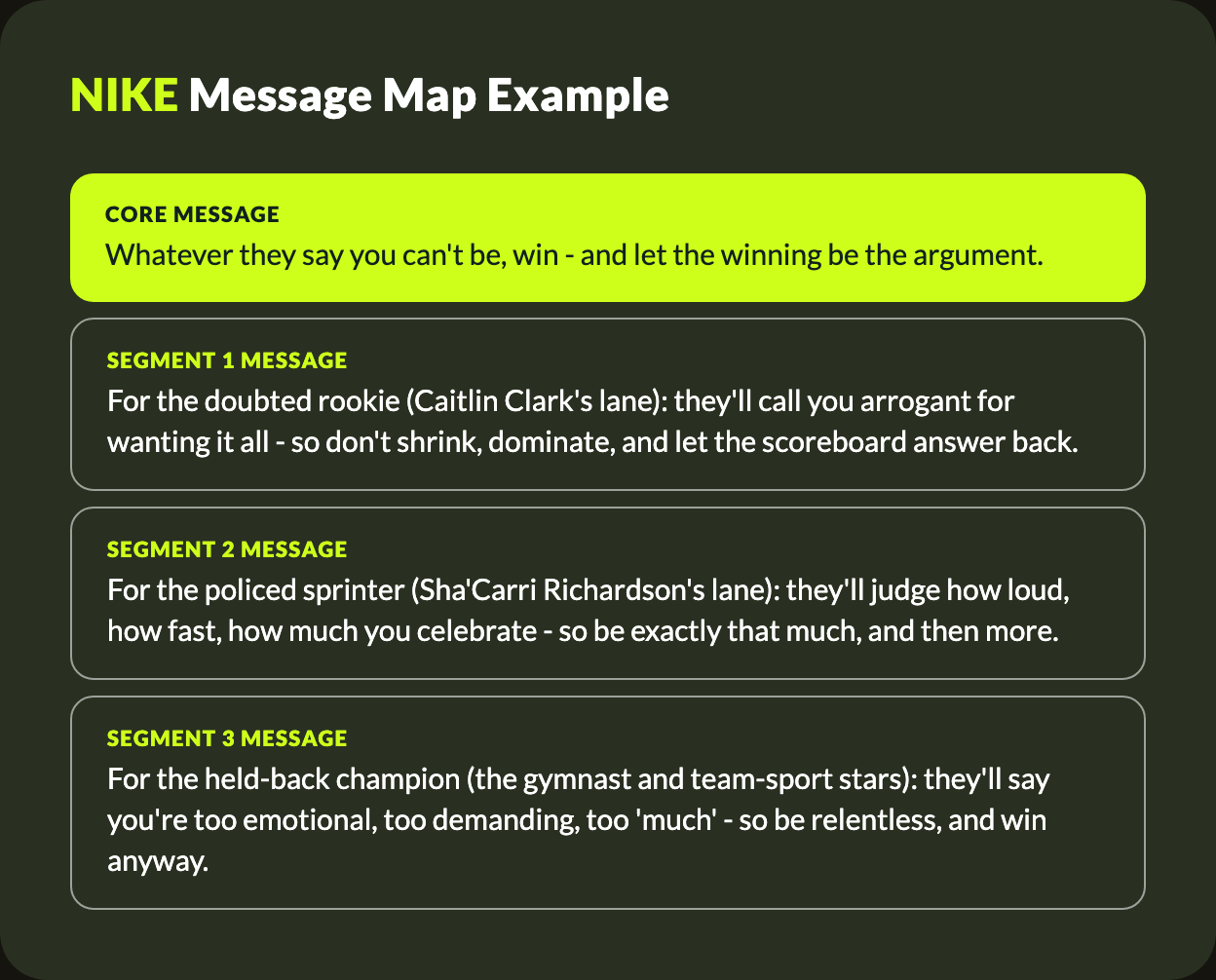
Message Map: Nike - see the full breakdown
Watch: Nike: So Win. - see it in our campaigns library
Confuse the Idea Cascade with the Message Map and you will tie yourself in knots. The Cascade is one idea going deeper - from thought to thing. The Map is one message going wider - from one person to many. Vertical versus horizontal. Both keep a single idea coherent, just along different axes.
How to actually pick one
You do not need all four every time. Usually you need the right one at the right moment.
Don't know what to say yet? Start with the Venn Diagram or the Pyramid of Truth. They find the message.
Got a great idea and need to keep it brave through execution? Run the Idea Cascade.
One message, several very different audiences? Build a Message Map.
The honest catch with all of them: a framework will happily hold a hollow idea in a beautiful shape. It will not tell you the idea was hollow. That part is still yours. What these tools do is remove the excuses - no more "we never quite nailed the message," no more campaigns that pull in four directions because four people each had a favourite sentence.
So pick the one that matches the job in front of you, and put the message somewhere a stranger could read it once and say it back. That is the only test that matters. Everything in the frameworks library is sitting right here with a live diagram and worked examples, waiting for you to stop circling the brief and write the line.