Lean Canvas
A One-Page Business Plan You Can Actually Change
The Lean Canvas is what happens when an entrepreneur gets annoyed with a business plan. In 2010, Ash Maurya took Alex Osterwalder's Business Model Canvas, found it described successful companies beautifully and struggling startups badly, and swapped four of its nine boxes. Out went Key Partners, Key Activities, Key Resources and Customer Relationships. In came Problem, Solution, Key Metrics and Unfair Advantage - the four things a new venture is most likely to get wrong.
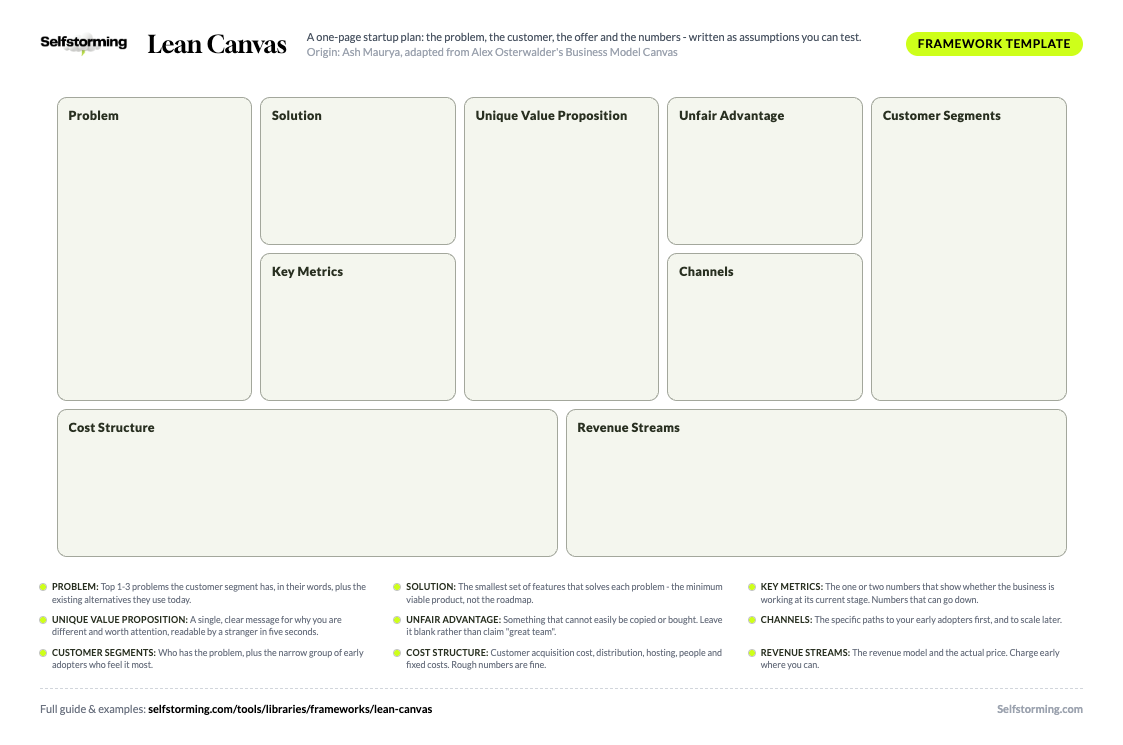
Print it. Fill it in.
The Lean Canvas as a printable A4 worksheet - write straight into the framework, on paper or in any PDF app.
Download the PDF templateKnowledge Worth Paying For
A working library of brand strategy frameworks - with worked examples on real brands, sources, and decision criteria. Not vibes.
One good deck covers the subscription. The rest is profit.
Nine boxes on one page: Problem (the top 1-3 problems), Customer Segments (who has them, and who the early adopters are), Unique Value Proposition (a single clear message for why you are different), Solution (the smallest set of features that solves the problem), Channels (how you reach customers), Revenue Streams and Cost Structure (the money), Key Metrics (the numbers that show it is working) and Unfair Advantage (what nobody can copy or buy). The rule that makes it useful: every box is an assumption. Fill it in fast, find the riskiest box, and test that one first.
Dollar Shave Club
Razor subscription (USA, launched 2012) - illustrative canvasAn illustrative launch-stage canvas, reconstructed from what the company did publicly in 2012, not from internal documents. It shows how tight the canvas can be when the problem is obvious and the existing alternative is resented. The Unfair Advantage is the interesting box: not a patent or a factory, but a founder-led voice that the category leaders could not copy without looking ridiculous.
Monzo
Mobile bank (UK, started 2015) - illustrative canvasAn illustrative early-stage canvas for a fintech, reconstructed from public information rather than company documents. It shows a Lean Canvas where the riskiest box is not the product but trust: people had to believe a startup with an app could hold their money. The Unfair Advantage is a community that helped build and test the product in public.

Linear
Issue tracking software for product teams (USA, founded 2019) - illustrative canvasAn illustrative B2B canvas, reconstructed from Linear's public positioning, not internal documents. It shows how a crowded category (project management tools) can still have a sharp Problem box when the segment is narrow enough: software teams frustrated by slow, bloated tools. The UVP leans on speed and craft, which is easy to claim and hard to copy if you actually deliver it.
Dollar Shave Club, Monzo, Linear - filled in, line by line. Unlock to read them.
Dollar Shave Club (Razor subscription (USA, launched 2012) - illustrative canvas)
An illustrative launch-stage canvas, reconstructed from what the company did publicly in 2012, not from internal documents. It shows how tight the canvas can be when the problem is obvious and the existing alternative is resented. The Unfair Advantage is the interesting box: not a patent or a factory, but a founder-led voice that the category leaders could not copy without looking ridiculous.
Problem: Blades are overpriced and bought from a locked cabinet. Alternatives: supermarket brands, disposables, growing a beard.
Customer Segments: Men who shave several times a week. Early adopters: 20-35s who buy online and think the razor aisle is a scam.
Unique Value Proposition: A decent razor for a few dollars a month, delivered to your door.
Solution: Twin-blade razors by mail on a monthly plan. Cancel online in one click.
Channels: A launch video built to be shared, then YouTube, Facebook, word of mouth and referral credit.
Revenue Streams: Monthly subscription from about $1 a month, upsells like shave butter and wipes.
Cost Structure: Blades sourced from an existing manufacturer, fulfilment, shipping, the video, a small team.
Key Metrics: Subscribers still active after month three. Cost to acquire one subscriber.
Unfair Advantage: A founder-led, irreverent voice the big razor brands would never risk.
Monzo (Mobile bank (UK, started 2015) - illustrative canvas)
An illustrative early-stage canvas for a fintech, reconstructed from public information rather than company documents. It shows a Lean Canvas where the riskiest box is not the product but trust: people had to believe a startup with an app could hold their money. The Unfair Advantage is a community that helped build and test the product in public.
Problem: Banking apps are slow and opaque. Card fees abroad, no real-time balance. Alternatives: high-street bank apps, spreadsheets.
Customer Segments: Smartphone-first 20-40s in the UK. Early adopters: tech workers who travel and like trying new apps.
Unique Value Proposition: A bank that lives in your phone: instant notifications, honest fees, money you can see.
Solution: A prepaid card with a real-time app, then a full current account. Fee-free spending abroad.
Channels: Waitlist and invite queue, an open community forum, word of mouth, crowdfunding rounds.
Revenue Streams: Card interchange, then overdrafts, loans and paid account tiers.
Cost Structure: Banking licence and compliance, card issuing, engineering, customer support.
Key Metrics: Share of users paying their salary in. Weekly active card users.
Unfair Advantage: A community that co-designed the product in public, before the big banks noticed.
Linear (Issue tracking software for product teams (USA, founded 2019) - illustrative canvas)
An illustrative B2B canvas, reconstructed from Linear's public positioning, not internal documents. It shows how a crowded category (project management tools) can still have a sharp Problem box when the segment is narrow enough: software teams frustrated by slow, bloated tools. The UVP leans on speed and craft, which is easy to claim and hard to copy if you actually deliver it.
Problem: Issue trackers are slow, cluttered and built for managers, not engineers. Alternatives: Jira, spreadsheets, GitHub issues.
Customer Segments: Software teams of 10-200. Early adopters: startup engineers and designers who care about tools.
Unique Value Proposition: Issue tracking that is fast enough that engineers actually want to use it.
Solution: Keyboard-first tracker, cycles, Git integration, a fast app built for speed.
Channels: Word of mouth among startups, founder content, invite-based early access, a free plan.
Revenue Streams: Per-seat subscription, free tier for small teams, enterprise plans.
Cost Structure: A small senior product team, hosting, sales for larger accounts.
Key Metrics: Weekly active teams. Free-to-paid conversion within 60 days.
Unfair Advantage: Design and engineering craft that larger incumbents struggle to match.
1. Problem
What are the top one to three problems your customers have, and how do they solve them today?
The left-hand column and the place to start. List the top one to three problems your customer segment has, in their words, plus the existing alternatives they use today - a competitor, a spreadsheet, a workaround, or doing nothing. If customers already solve the problem well enough with something free, you have learned the most important thing on the canvas.
Good answer: Razor blades cost a fortune, and buying them means queuing for a locked cabinet. Alternatives: Gillette from the supermarket, disposable razors, beards. Specific, in the customer's language, and it names what they do today.
Wrong answer: Men lack access to a convenient, high-quality shaving solution. Written like a market report. No customer talks like this, and it names no alternative, so it can never be wrong.
2. Customer Segments
Who has these problems, and which early adopters feel them most sharply?
Who the problems belong to. Name the broad segment and, more importantly, the early adopters: the narrow group who feel the problem most and will try an unfinished product. "Everyone who shaves" is a market. "Men in their 20s and 30s who shave daily and resent the price" is someone you can find and talk to this week.
Good answer: Men who shave several times a week. Early adopters: guys in their 20s and 30s who buy online and already think the razor aisle is a scam. A segment plus a reachable first group.
Wrong answer: Men aged 18-65. A demographic, not a segment. It tells you nothing about who has the problem badly enough to switch.
3. Unique Value Proposition
What single, clear message explains why you are different and worth paying attention to?
The centre of the canvas and the hardest box to write. One sentence that a stranger understands in five seconds and that explains why you, not the existing alternatives. Maurya adds an optional high-level concept as an analogy ("YouTube for X"). If your UVP could sit on a competitor's homepage unchanged, it is not unique yet.
Good answer: A great razor for a few dollars a month, delivered to your door. Price, quality and convenience in one line, and it says exactly what the supermarket does not.
Wrong answer: The best shaving experience, powered by innovation. Every razor brand on earth could sign it. A UVP that is true of the category is not a proposition.
4. Solution
What is the smallest set of features that solves each problem?
Deliberately a small box. For each problem, write the simplest thing that solves it - your minimum viable product, not your roadmap. Maurya kept the box small because founders love their solution most and validate it least. If the Solution box is longer than the Problem box, the canvas is describing a product you want to build, not a problem customers have.
Good answer: Twin-blade razors by mail on a monthly plan. Cancel online in one click. Two features, each tied to one problem.
Wrong answer: Personalised AI shaving profiles, smart handle, app with skin analytics, loyalty points. A roadmap, not a minimum. Nothing here has been tested against the problem.
5. Channels
How will you reach your early adopters, and which path can grow with you?
The paths to customers, free and paid, inbound and outbound. Early on, the useful question is which channel can reach your early adopters cheaply enough to learn from them. Later it becomes which channel can scale. "Social media" is not a channel plan - name the platform, the format and the first hundred people.
Good answer: A launch video built to be shared, then YouTube and Facebook, word of mouth and a referral credit. Concrete, ordered, and matched to where the early adopters already are.
Wrong answer: Digital marketing, social media, partnerships. Categories, not channels. Nothing here tells you what to do on Monday.
6. Revenue Streams
How do you make money, and what will customers pay?
The revenue model, the price and the lifetime value you expect. Maurya's advice is to charge from day one where you can, because a price is the clearest test of whether the problem is real. Write the actual number, not "subscription".
Good answer: Monthly subscription, roughly $1-9 a month depending on the blade, plus add-ons like shave butter. A model, a price range and an upsell.
Wrong answer: Freemium, ads, and maybe enterprise later. Three models and no price. It hides the real question: will anyone pay for this?
7. Cost Structure
What does it cost to acquire a customer, build the product and keep the lights on?
Customer acquisition cost, distribution, hosting, people and the fixed costs you carry every month. Put a rough number on the burn and on what one customer costs to win. Together with Revenue Streams it shows when the business can break even, or how much time you have to find out.
Good answer: Blades bought from an existing manufacturer, fulfilment, shipping, the launch video, a small team. No factory, so fixed costs stay low.
Wrong answer: Standard operating costs. Says nothing. If you do not know your costs, write the guess and mark it as a guess.
8. Key Metrics
Which one or two numbers tell you whether this is working right now?
The few numbers that show progress at the current stage. Early on they are usually activation and retention ("share of sign-ups who reorder"), later growth and revenue. Maurya quotes Noah Kagan: a startup can only focus on one metric. Pick it, and ignore the vanity numbers that only ever go up.
Good answer: Subscribers who stay past month three. Cost to acquire one subscriber. Two numbers, and both can go down.
Wrong answer: Website traffic, followers, app downloads, impressions. Vanity metrics. They rise whether or not the business works.
9. Unfair Advantage
What do you have that cannot easily be copied or bought?
The box Maurya expected to be blank on day one. An unfair advantage is something a well-funded competitor cannot copy or buy: proprietary data, a community, network effects, insider knowledge, an existing audience, a brand voice that would be awkward for incumbents to imitate. Leave it empty rather than fill it with "great team".
Good answer: A founder-led, irreverent brand voice the big razor brands would never risk. Hard for an incumbent to copy without embarrassing itself.
Wrong answer: First-mover advantage and a passionate team. Every startup claims both. Neither stops a fast follower with more money.
Decide your starting point: You do not need a whiteboard and a free afternoon. On Selfstorming you can run a Research Session to map competitors, existing alternatives and category data first, then fill the canvas with those inputs in front of you. Whatever you start from, treat the first version as a list of guesses to check, not a plan to defend.
Fill it in fast: Give yourself about twenty minutes for the first version. Short phrases, not paragraphs. A canvas that takes a week to write has turned into a business plan, and you will be too attached to it to change it.
Start with customers and problems: Write Customer Segments and Problem together, because each defines the other. List the existing alternatives next to the problems. If the honest alternative is "nothing, they live with it", ask how much the problem really hurts.
Write the UVP for a stranger: One sentence, no jargon, readable in five seconds. Test it on someone outside your team and ask them to explain back what you do. If they cannot, rewrite it before you touch the Solution box.
Keep the Solution small: For each problem, write the smallest thing that solves it. Resist listing the roadmap. The Solution box is small on purpose.
Put numbers on the money boxes: Write a real price in Revenue Streams and real guesses in Cost Structure, including what one customer costs to acquire. If the numbers do not work on paper, they will not work in the market.
Find the riskiest box: Mark every box green (evidence), amber (reasonable guess) or red (pure guess). The red box most likely to kill the business is your next experiment - usually the Problem or the Channels, rarely the Solution.
Test it, then rewrite the canvas: Run the smallest test that can prove the riskiest assumption wrong - customer interviews, a landing page, a pre-sale. Update the canvas with what you learned and keep the old versions. The history of your canvases is a record of what you learned.
Best for: New ventures still searching for a business model: startups, new products inside a company, side projects, a pivot. Anywhere the main risk is building something nobody wants. / Describing or optimising a mature business with stable customers, where partners, resources and operations matter more than finding product-market fit.
Output: A one-page, nine-box canvas of assumptions, with the riskiest box flagged as the next experiment. / A financial model, a brand strategy or a go-to-market plan. The canvas points at what to test; it is not the plan itself.
Time to complete: Twenty minutes for a first version, then a rewrite after every meaningful experiment or customer conversation. / A multi-week workshop deliverable. A Lean Canvas that took a month to write will not get rewritten.
vs Business Model Canvas: Use the Lean Canvas while you are still finding the model: it swaps Key Partners, Key Activities, Key Resources and Customer Relationships for Problem, Solution, Key Metrics and Unfair Advantage. / Use the Business Model Canvas once the model works and you need to describe how it runs - partners, activities, resources and relationships become the real questions.
vs Value Proposition Canvas: The Lean Canvas covers the whole business on one page, with the value proposition as one box. / The Value Proposition Canvas zooms into that one box: customer jobs, pains and gains against your product. Use it when the UVP is the riskiest assumption.
vs TAM SAM SOM: The Lean Canvas asks whether the business can work at all. / TAM SAM SOM asks how big it could get. Run the canvas first, then size the market for the segment that tested well.
The Lean Canvas was created by entrepreneur Ash Maurya in 2010. Maurya had met Alex Osterwalder's Business Model Canvas through the book Business Model Generation and initially dismissed it as too simple, partly because its examples described companies after they had succeeded. Seeing Rob Fitzpatrick's Startup Toolkit variation, which folded in Steve Blank's customer development worksheets, changed his mind. He started "trading boxes": out went Key Partners, Key Activities, Key Resources and Customer Relationships, which he felt helped outsiders understand a business; in came Problem, Solution, Key Metrics and Unfair Advantage, which he felt captured what was most risky for the entrepreneur. He published the adaptation in August 2010 in a post called "How I Document My Business Model Hypotheses", and it became the backbone of his book Running Lean, republished by O'Reilly in 2012. It sits inside the wider Lean Startup movement around Eric Ries and Steve Blank, which treats a new business as a series of experiments rather than a plan to execute.
The Lean Canvas is criticised from both sides. Business-model purists point out that it drops partners, resources and operations, which are often exactly where a business that has found customers runs into trouble - which is why Maurya positions it for the search phase, not the running phase. The wider Lean Startup movement has its own critics: investor Ben Horowitz argued in 2010 that "running lean" can become an end in itself, and that some markets reward spending heavily to win early. A more practical critique is that the canvas is easy to fill and hard to use well. Nine confident sentences look like strategy, and many teams never get to the part that matters - picking the riskiest assumption and testing it. Used as a living list of bets, it is one of the most useful one-page tools a founder has. Used as a workshop handout, it is a nicely formatted guess.
What is a Lean Canvas?
A Lean Canvas is a one-page business plan for startups and new products, created by Ash Maurya in 2010 as an adaptation of Alex Osterwalder's Business Model Canvas. It has nine boxes: Problem, Customer Segments, Unique Value Proposition, Solution, Channels, Revenue Streams, Cost Structure, Key Metrics and Unfair Advantage. Each box holds an assumption, not a fact, and the point of the canvas is to find the riskiest assumption and test it before you spend months building.
What is the difference between Lean Canvas and Business Model Canvas?
Both use the same nine-box grid, but they answer different questions. The Business Model Canvas describes how an existing business works, so it has boxes for Key Partners, Key Activities, Key Resources and Customer Relationships. The Lean Canvas swaps those four for Problem, Solution, Key Metrics and Unfair Advantage, because a startup's biggest risks are building something nobody needs and not knowing whether it is working. Use the Lean Canvas while you are still searching for a business model, and the Business Model Canvas once you have one to run.
How do you fill in a Lean Canvas?
Start with the customer, not the product: fill in Customer Segments and Problem together, then the Unique Value Proposition, then the Solution. Add Channels, Revenue Streams and Cost Structure next, then Key Metrics, and leave Unfair Advantage for last, often blank. Write short, specific phrases rather than paragraphs, aim to finish a first version in about 20 minutes, and mark which box you are least sure about. That box is your next experiment.
What is a Lean Canvas example?
A good Lean Canvas example is an early-stage subscription business such as Dollar Shave Club in 2012. Problem: razor blades are expensive and buying them is annoying. Customer segment: men who shave and resent paying for it. Unique value proposition: a decent razor delivered for a few dollars a month. Unfair advantage: a founder-led brand voice nobody else in the category dared to use. This page walks through three worked examples, including a fintech and a B2B software tool.
What goes in the Unfair Advantage box of a Lean Canvas?
Something competitors cannot easily copy or buy: proprietary data, a community, network effects, a founder with rare expertise, an existing audience, exclusive distribution. "Great product", "first mover" and "passionate team" do not count, because anyone can claim them. Ash Maurya's own advice is that the box is often blank on day one. Leaving it empty is more honest than filling it with an advantage you do not have, and it reminds you to build one.
Is the Lean Canvas only for startups?
No. The Lean Canvas was built for startups, but it works for any new venture inside an existing company: a new product line, a new market, an internal tool you want people to pay for, or a side project. It is less useful for mature, stable businesses, where the risks are about operations and partners rather than whether customers want the thing. For those, the Business Model Canvas is the better fit.
What are Key Metrics in a Lean Canvas?
Key Metrics are the few numbers that tell you whether the business is working at its current stage. Early on they are usually activation and retention measures, such as the share of sign-ups who complete the core action or come back in week two. Later they shift to growth and revenue. A Lean Canvas with ten metrics has none: pick the one or two numbers you would check first every Monday.
Where can I get a Lean Canvas template?
This page includes a free printable Lean Canvas template in the same nine-box layout, plus three filled-in examples you can copy the structure from. Print it, fill it in with a pencil, and redo it every few weeks as your assumptions change. A Lean Canvas is meant to be rewritten, so a clean template you can fill in again beats a polished version you never update.
A one-page startup plan: the problem, the customer, the offer and the numbers - written as assumptions you can test.
All 50 frameworks, ready to use.
The PDF book with worked examples and printable templates, the editable PowerPoint and an MD file for your AI. €39.90, or free with a yearly plan.
See the ebook packThe result is a one-page plan you can write in twenty minutes and rewrite every few weeks, which is the whole point. Every box is a guess. The canvas exists so you can see all the guesses at once, find the one most likely to sink you, and test it before you build anything expensive. Founders who treat it as a pitch slide fill it with confident sentences and learn nothing. Founders who treat it as a list of bets know what to test on Monday. This page covers the nine boxes in the order you should fill them, how Lean Canvas differs from the Business Model Canvas, and three worked examples from a razor subscription to a fintech app.
Related Frameworks
Playing to Win
Five linked choices, top to bottom: Winning Aspiration (what winning looks like, for whom), Where to Play (the specific market, segment, geo
OKRs
One Objective (qualitative, ambitious, memorable - the hill worth taking) plus three Key Results (numeric, measurable, with zero grey area -
SWOT Analysis
Four boxes, two axes: Strengths and Weaknesses are internal and controllable, Opportunities and Threats are external and mostly not. Left si
Eisenhower Matrix
Score every task on two axes: important (does it matter to your goals?) and urgent (does it need attention now?). That gives four boxes. Do