Test hundreds of angles on Meta, graduate the winner to YouTube, then commit the TV budget. Eucalyptus, HexClad and a $2,000 billboard show how the brand vs performance war ends: with one loop, running in both directions.
The most expensive sentence in advertising is "we will know if it worked when the campaign is over." I have said it. In an agency, the TV spot is the big bet, the brand film is the big bet, and everything on Meta is the small change that pays for the coffee. So you brief the big bet on instinct, shoot it, and find out six weeks later whether the instinct was right.
Carly Griffin, Head of Growth at Eucalyptus, runs it the other way round. In the Tracksuit x MagicBrief brand-and-performance webinar, she describes a process she calls creative graduation, and it is the most practical answer I have heard to the question every marketing team is still arguing about.
Brand and performance are just channels
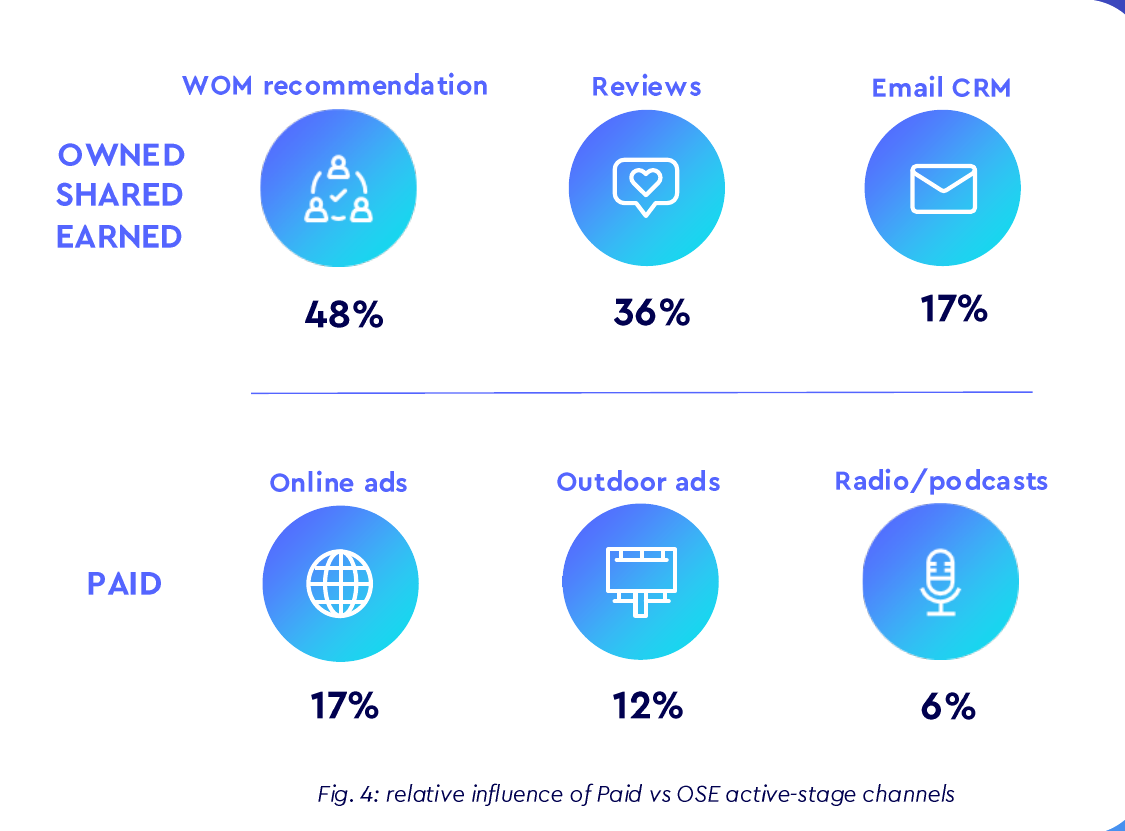
Griffin's background is media buying. She came into Eucalyptus, the Australian telehealth group behind Juniper, Pilot and Skin Software, as the person who loved pushing a button in Meta and seeing a metric move the next morning. Her first reframe is the one that kills the argument: "Brand and performance are just channels. Your job is to find attention at the best value, and then make that attention count." The media buy finds the attention. The creative makes it count. Everything else is a naming convention.
Her own example is a Pilot billboard for a men's health product that the site owner pulled after roughly a day. The buy was fine, not spectacular. The creative was the X factor. And the photo of the billboard, plus the small scandal of it being taken down, travelled through paid social and organic for far longer than the billboard stood. The channel lasted a day. The attention lasted weeks.
The graduation ladder
Here is the loop, as Griffin runs it across the Eucalyptus brands:
1. Test the angle on Meta. It is cheap, the data arrives tomorrow, and you can try messages, creators, colours and formats "ad nauseam". Hundreds of ads around one insight is normal. For Juniper, the medical weight-loss brand, the insight was that people saw medical weight loss as cheating, an easy way out. That is an argument you can win, so they tested dozens of ways to win it.
2. Graduate the winner to YouTube. Once a message keeps working from different angles, you have the confidence to spend on production. Juniper's motion designer built a proper explainer on why it is not cheating, and it performed on a second channel with its own reliable numbers.
3. Commit the TV budget. By now the angle has proven itself twice. The TV campaign is no longer a bet on instinct; it is a scale-up of something consumers have already voted for.
4. Extend into PR, website and organic. Juniper's latest move was a national white paper on sentiment around medical weight loss. Same message, new format, earned reach.
Look back at the end and you have one unified message on every channel, and you never had to guess. Griffin admits that expanding into brand "really terrified me" as a performance person. The ladder is what gave her the confidence. It is also, quietly, a creative testing framework with a brand budget bolted on top.
Creative is the new targeting
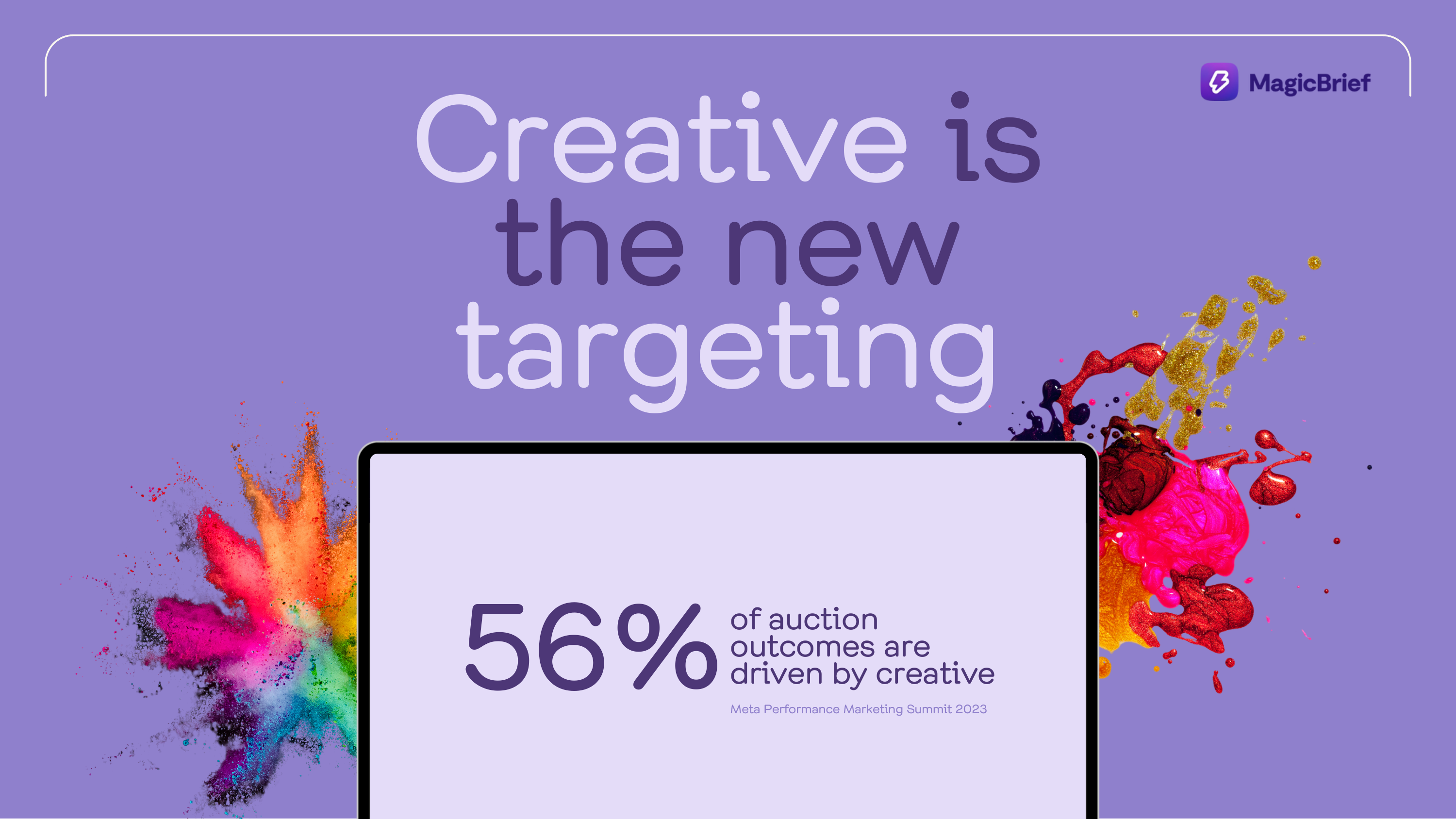
George Howes, co-founder of MagicBrief and a former creative director at Eucalyptus, adds the reason this works better now than it did five years ago. Meta has been retiring interest targeting. What decides who sees your ad is increasingly the ad itself.
Source: MagicBrief, Brand x Performance webinar deck, citing Meta Performance Marketing Summit 2023
Meta says 56% of auction outcomes are driven by the creative. That means a performance channel is now the fastest, cheapest way to learn what your brand should be saying, because the algorithm is doing the audience research for you. Howes' point is that performance marketing was never only a last-click conversion event. Short-form video is storytelling at scale, to exactly the right people, with a feedback loop attached. The digital-native brands that grew up on it, Gymshark, Hismile, Wild (acquired by Unilever), did not skip brand. They built it in the channel everyone else called "performance".
The loop runs in both directions
The best case in the webinar is HexClad, the cookware brand.
Source: MagicBrief, Brand x Performance webinar deck
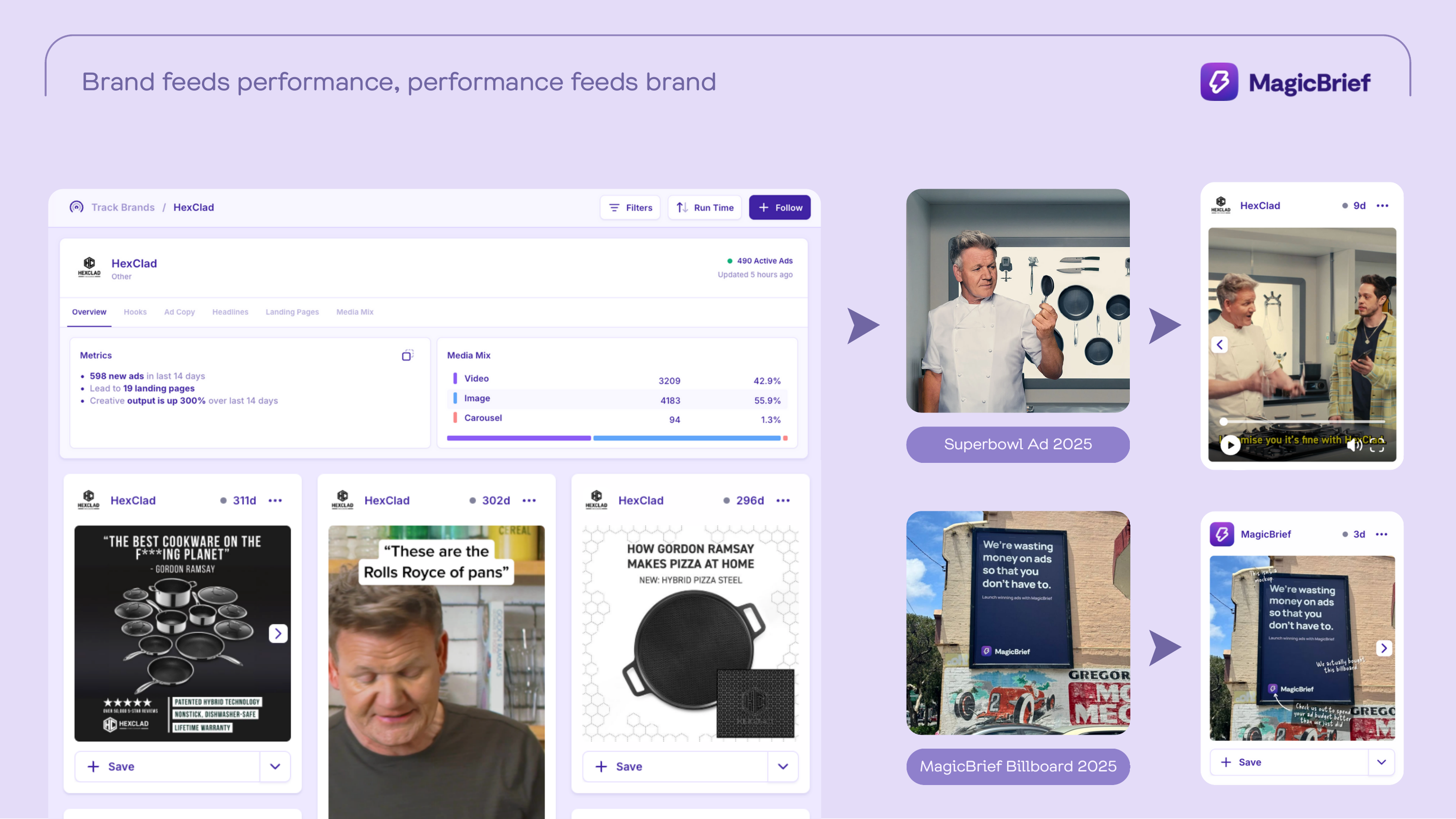
HexClad saw in its ad account that anything with Gordon Ramsay in it outperformed everything else. So they went deeper: a partnership, then Ramsay investing in the company, then a Super Bowl ad in 2025 with Ramsay and Pete Davidson. A Meta insight became the most expensive brand placement on earth. And then they cut the Super Bowl ad back into a range of Facebook ads, carrying the celebrity and the production value into a channel that can put it in front of people who like Ramsay, like cooking, and were about to buy a pan anyway.
MagicBrief could not afford a Super Bowl ad. They bought a billboard in Surry Hills, Sydney, for about $2,000. Howes is honest about why: "The reason we ran the billboard wasn't because we thought a ton of people would see it, but so that we could run the picture of that billboard on Facebook." You get the credibility of brand advertising with the reach and targeting of performance. The billboard was a prop. The ad was the campaign.
I love this because it is exactly the trick agencies used to do the other way round: shoot a TVC, then cut it down for digital as an afterthought. Howes and Griffin start from the cheap, learnable end and graduate upwards, then loop back down. Same assets, opposite logic, much less guessing.
One funnel, two entrances
Source: MagicBrief, Brand x Performance webinar deck
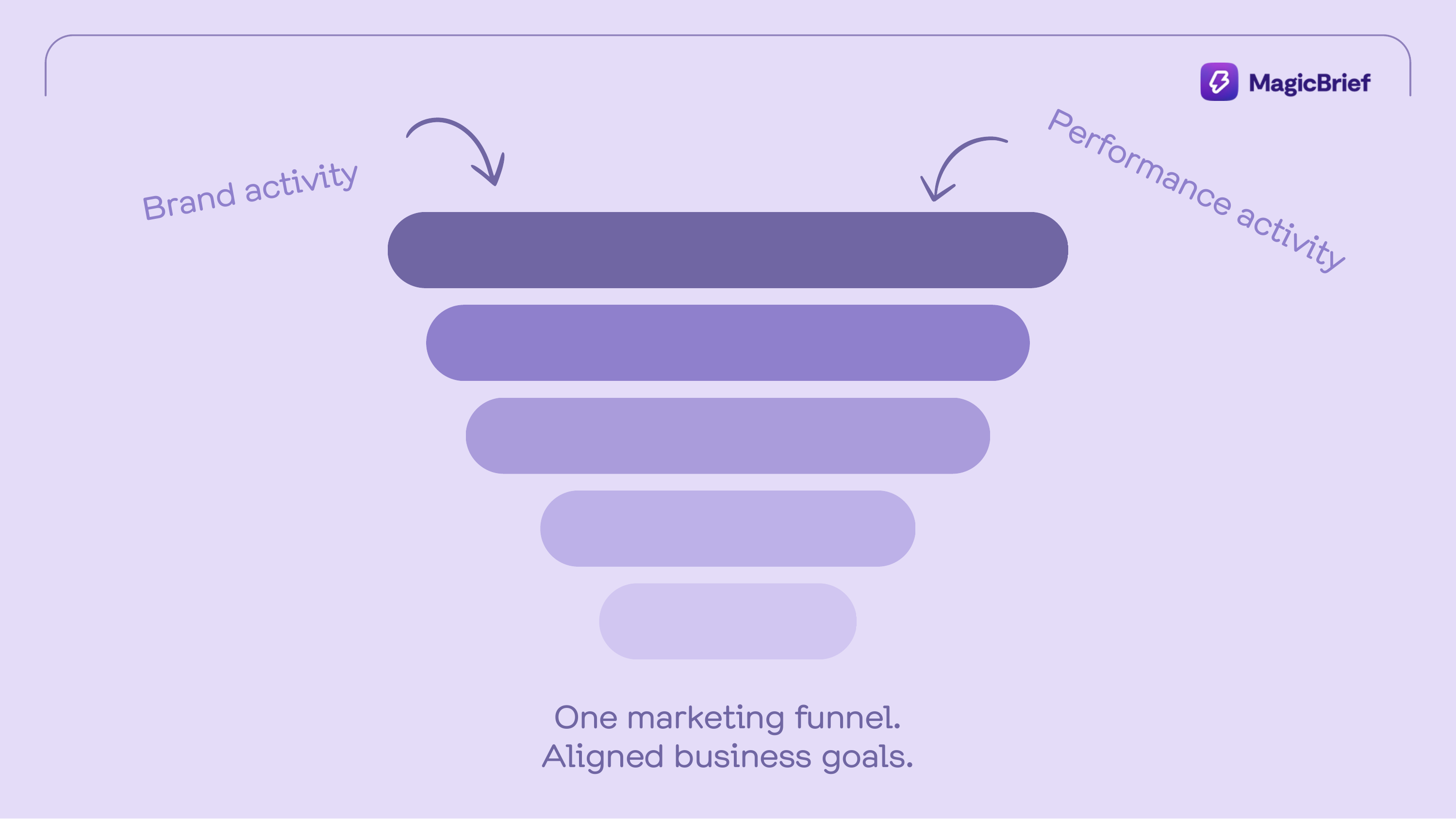
The slide that ends Howes' section is a single funnel with brand activity and performance activity both pouring into the top. Not two funnels. Not a brand funnel that hands off to a performance funnel. One funnel, aligned business goals, two ways in.
Which is also why Eucalyptus reorganised. Three years ago they had a brand team and a performance team, and the brands grew but not fast enough. Now every brand has one full-stack team: a growth or creative lead, a growth marketer, creatives, a producer, one budget and one set of targets. Griffin's hiring rule is to look for storytellers in every role, videographers and media buyers included, because "if it all relies on one person driving the story home, you're not going to grow the brand at the speed you need."
Try it at a size you can afford
You do not need a Super Bowl or a telehealth group to run the ladder. Pick one insight your brand can argue about, the way Juniper argued that medical weight loss is not cheating. Test ten ways of saying it on Meta this month. Take the one that survives to a proper video next month. Only then put it on a billboard, or a TV plan, or the side of a tram. And when the tram photo comes back, put it in the ad account.
If you want the ideas for step one, a Creative Inspiration Session will give you more angles than your ad account can test. The rest is graduation.