New data shows marketers think creativity is a risk. They’re wrong. Being boring is the most expensive mistake in your budget. Here's the science of why.

The Great Delusion: Why We Fear the Only Thing That Works
I recently stumbled upon a report from System1 and Effie that should make every creative strategist's eye twitch. Apparently, a significant chunk of brand managers today view 'creative' campaigns as a risk. Yes, you read that correctly. In an era where we have more data than sense, the very thing that differentiates a brand from a generic commodity is being treated like a live grenade in a boardroom.
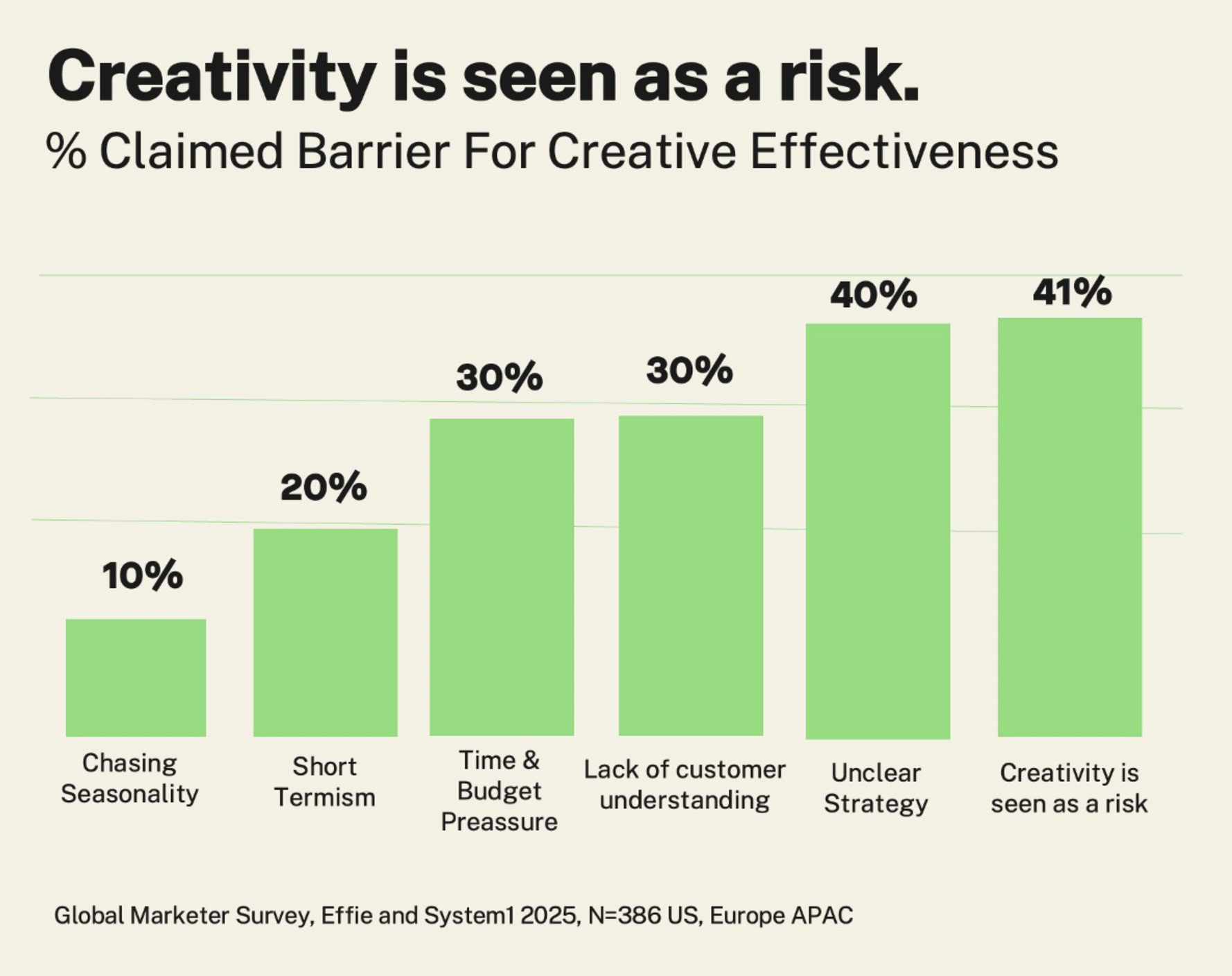
It is a classic case of what I call 'Corporate Alienation Paranoia.' We are so terrified of doing something 'weird' that we’ve collectively decided that being invisible is a safer career move. But let’s look at the cold, hard marketing science before we all start making ads that look like stock photos of people pointing at tablets. According to System1’s analysis of over 100,000 ads, about 50% of them had exactly zero impact on brand growth. Zero. Nula. Nothing. Why? Because they were too safe to be noticed. They failed The Law Of Being Ignored, which states that neutral, safe advertising is the biggest financial drain in your budget.
"The most expensive thing you can do in marketing is spend a million dollars on a campaign that nobody remembers because you were too afraid to offend a goldfish."
The 11x Efficiency Gap
If you think creativity is a risk, you are essentially saying that efficiency is a risk. Research from the IPA has shown that highly creative campaigns can be up to 11 times more effective at driving market share growth than their 'safe' counterparts. Why? Because humans are not the rational, spreadsheet-driven creatures we pretend they are in our 4C Framework decks. We are emotional animals who use logic to justify our impulses.
When a brand manager says, "Let’s just play it safe," what they are actually saying is, "Let’s ignore The Law Of Emotion Over Reason." Emotional advertising builds long-term memory structures. Rational, 'safe' advertising is processed and forgotten faster than a LinkedIn 'thought leader' post. If your ad doesn't trigger a spike in the amygdala, you aren't 'playing it safe' - you are donating your media budget to the platform's shareholders without asking for anything in return.
Why 'Safe' is the New 'Dead'
The Autopilot Problem: Most consumers are on a mental cruise control. To break through, you need a pattern interrupt. Safe ads blend into the scenery.
The Cost of Attention: If your creative is boring, you have to spend 10x more on media just to be seen. Creativity is the ultimate budget multiplier.
The Branding Fallacy: As one strategist noted, creativity without branding is a waste. But branding without creativity is just a logo on a blank wall.
Strategic Risk vs. Creative Suicide
The problem is that we’ve confused 'creativity' with 'randomness.' True creativity in advertising is Compound Creativity - the consistent application of distinctive assets and fresh perspectives.
Look at Burger King: The Moldy Whopper. Was it a risk? To a traditional brand manager, showing rotting food is a nightmare. But it was a strategic masterstroke that proved a point about preservatives more effectively than a thousand 'freshness' claims. It used Turn Weakness Into Strength to dominate the cultural conversation. That isn't a risk; that's an investment with a massive ROI.
Strategy Type | Perceived Risk | Actual Risk | Primary Outcome |
|---|---|---|---|
Safe & Conventional | Low | High (Invisible) | Media budget waste, zero recall, stagnation. |
Data-Led Boring | Very Low | High (Commodity) | Short-term ROI spikes, long-term brand death. |
Strategically Creative | High | Low (Distinctive) | 11x effectiveness, cultural relevance, ESOSV. |
Absurdly Creative | Very High | Moderate | High fame, but requires strong brand linkage. |
How to De-Risk Your Creativity
If you're still sweating about your next campaign, you don't need a bigger focus group; you need better tools. Creativity is only a risk when it's untethered from strategy. At Selfstorming, we built the Creative Session tool specifically to bridge this gap. It doesn't just give you 'ideas'; it gives you strategic springboards based on proven mechanics.
Stop asking "Is this too much?" and start asking "Will anyone notice this if we don't do it?" If you follow The Law Of Fluency, you know that the brain loves things that are easy to process but hard to ignore. A creative campaign that uses a familiar Analogy or a sharp Contrarian Statement isn't a gamble - it's a shortcut to the consumer's brain.
Actionable Takeaways for the 'Risk-Averse' Marketer
Define the Enemy: If you're afraid to stand for something, you'll fall for anything. Use the Find an Enemy technique to give your brand a reason to exist.
Test for Emotion, Not Just Recall: If they remember the ad but don't feel anything, you've failed. Use The Law Of Fame to measure your potential impact.
Kill the "Softened" Path: The more you dilute an idea to make it 'safe,' the more you ensure its failure. If the idea doesn't make you slightly uncomfortable, it's probably not creative enough to work.
Conclusion: The Year of Courage
We are heading into an era where AI can churn out 'safe' content by the billions. If your strategy is to be safe, you are competing with a machine that can be boring much faster and cheaper than you. Your only competitive advantage is the ability to be human, to be weird, and to be brave. Creativity isn't the risk. The risk is that in 2026, your brand will be the one that everyone politely ignores while they engage with a brand that had the guts to use Brutal Honesty or Parody as a Weapon.
So, the next time someone in a meeting calls a creative idea 'risky,' remind them of the most dangerous law in marketing. It's the silent killer that makes you feel successful today while your brand dies tomorrow. Choose creativity. It’s the only logical choice you have left.