Brand strategy frameworks for deciding what a brand actually is - identity, meaning, positioning. When each onion, pyramid and prism earns its place.
A brand strategy is the set of calls about what a brand actually is - its identity, what it means to people, where it stands against the alternatives, and why it deserves to exist at all. That is harder than choosing a colour, which is exactly why people choose the colour.
The frameworks we added to our library exist to drag those calls into the open. A framework is a forcing function - it makes you fill in the box you would otherwise hand-wave past. So let us walk the useful ones and be honest about when each earns its place.
The brand-definition models: onions, pyramids, prisms
These all answer the same question - "what is this brand, layer by layer?" - and only differ in how they slice it. Pick one. Run all four and you will get the same brand in four dialects and a team that quietly stops reading.
The Brand Onion is the friendliest place to start. Five layers, from outside in: attributes, benefits, personality, values, essence. You begin with the boring true stuff (what it does) and keep peeling until you hit the one word in the middle that is supposed to survive a rebrand. It is great precisely because it forces you to admit that "premium" is an attribute, not an essence.
The Brand Pyramid is a close cousin worth seeing in action. The diagram below shows it built out on Duolingo, climbing from base-level salience all the way up to the resonance that has people defending their streaks like heirlooms.
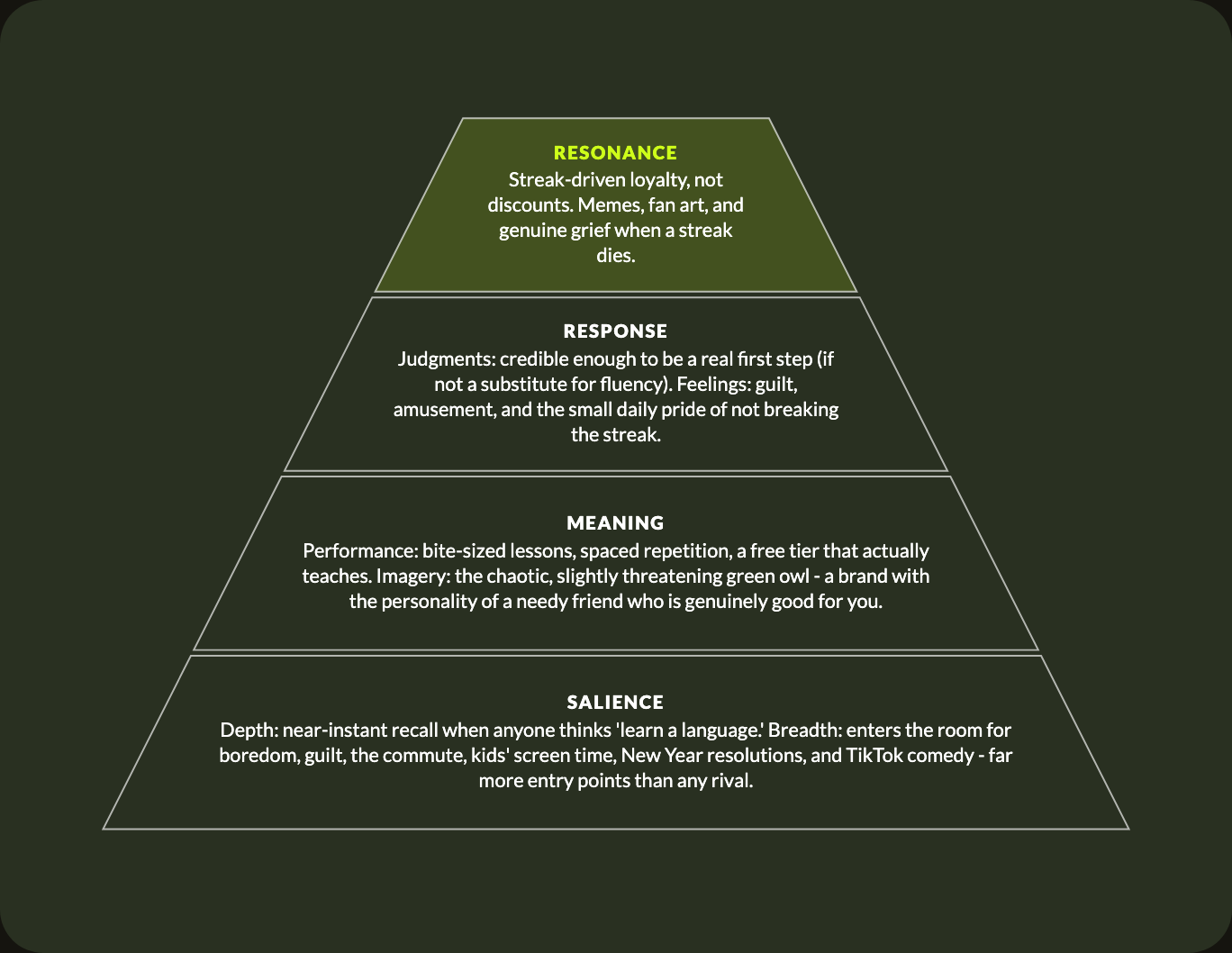
Brand Pyramid: Duolingo - see the full breakdown
Watch: Duolingo: Duo is Dead - see it in our campaigns library
Want more academic spine? The Brand Pyramid is Keller's CBBE model - Salience, Meaning, Response, Resonance, climbing from "who are you?" to "you and me, we're a thing now." Reach for it when leadership wants to know not just what the brand is, but how far up the loyalty ladder real customers have actually climbed.
The Brand Identity Prism (Kapferer) is the sophisticated European cousin. Six facets, and crucially it splits how you see your customer (reflection) from how the customer sees themselves (self-image). That gap is where a lot of brands quietly drown, and the prism is the only one here that makes you stare at it.
And the Brand Key is Unilever's eight-box machine, built outside-in until everything funnels into a single discriminator. Heavier than the onion - reach for it when the stakes (and the legal team) demand you show your working.
A framework does not give you the answer. It just makes it embarrassing to skip the question.
The ladders and the archetypes: personality with rails
Two tools here keep a brand from going full beige. The Brand Ladder climbs from features to functional benefits to emotional benefits to persona to essence. Same instinct as the onion, stretched vertical - the cleaner choice when your problem is specifically that nobody can explain why a feature should make anyone feel anything.
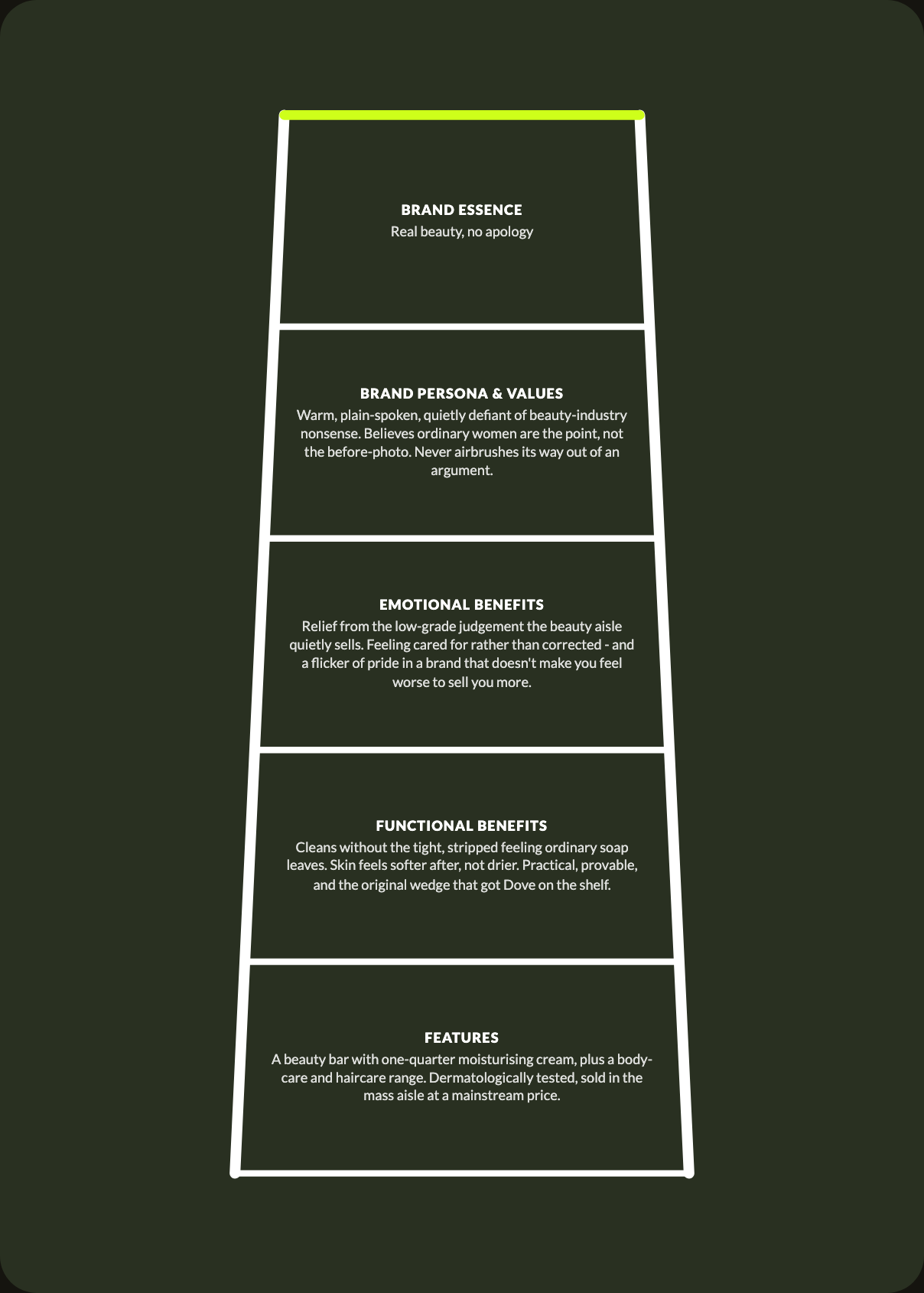
Brand Ladder: Dove - see the full breakdown
Watch: Dove: Beauty Sketches - see it in our campaigns library
The Brand Archetypes - the twelve from Mark and Pearson, Hero to Outlaw to Sage to Lover - are the fastest way to give a brand a recognisable temperament. Used well, they stop a brand sounding like a committee. Used badly, you get forty-seven "rebels" all selling oat milk. The archetype is a starting personality, not a finish line.
Positioning: the one most teams actually need
If you only do one of these, do this. The Positioning Statement is five slots - target, need, frame of reference, point of difference, reason to believe - and it is brutal in the best way, because you cannot fill in "point of difference" with a straight face if you do not have one. Nine times out of ten, identity confusion is actually positioning confusion wearing a costume. Write the statement first and half your onion fills itself in.
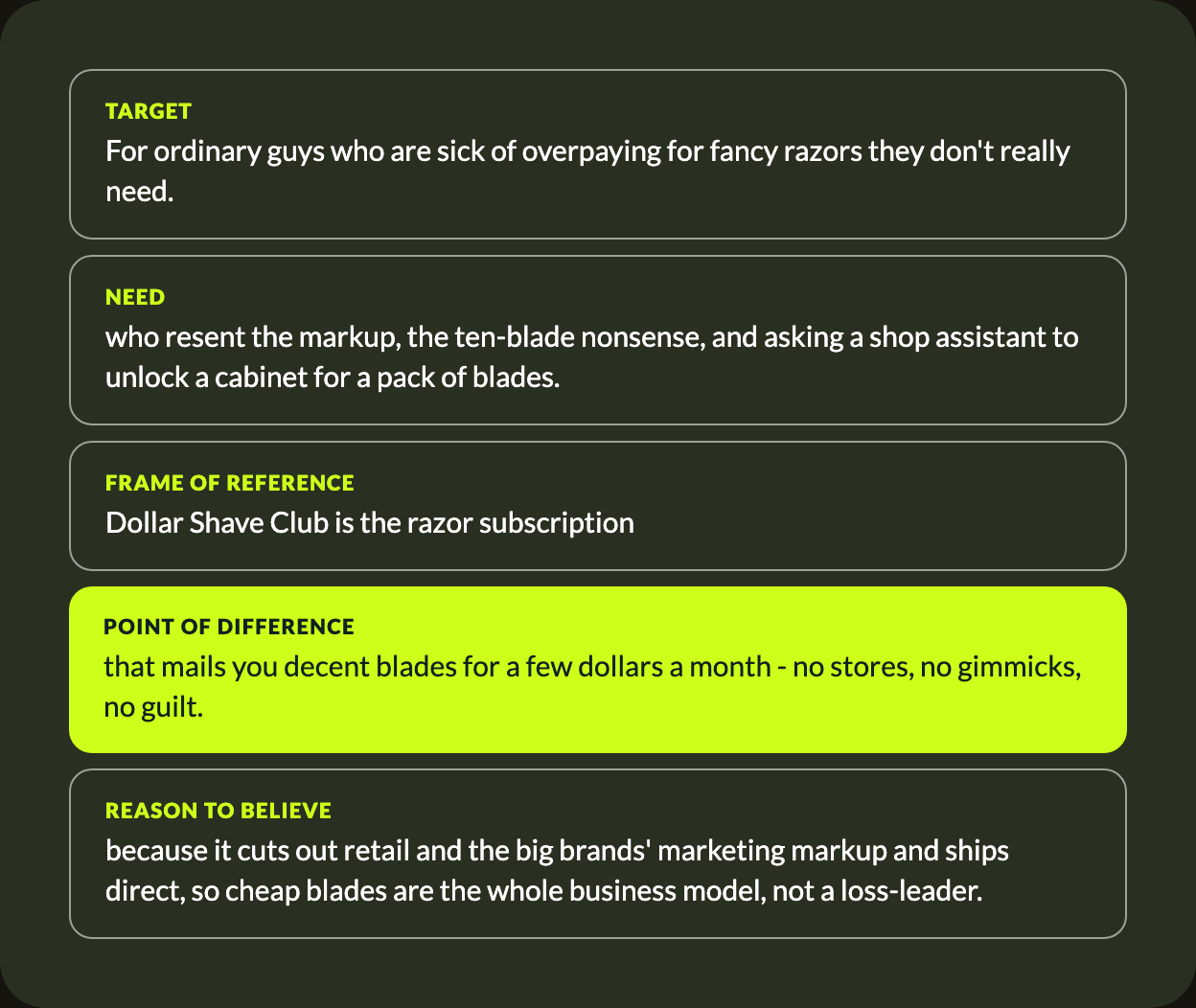
Positioning Statement: Dollar Shave Club - see the full breakdown
Watch: Dollar Shave Club: Our Blades Are F***ing Great - see it in our campaigns library
Purpose, vision, mission: the part that becomes wall art
The Purpose, Vision & Mission trio is the most abused corner of brand strategy - three sentences framed in reception and ignored by everyone who walks past them. Done right it is genuinely useful: a concrete mission (what we do now), a falsifiable vision (the future we are betting on), a north-star purpose (why we bother). The test is whether anyone could ever prove the vision wrong. If not, you have written a horoscope, and the framework's job is to keep you out of horoscope territory.
Distinctive assets and the Golden Circle: fame, and the inside-out story
Then there is the Ehrenberg-Bass corrective to all of the above. Distinctive Brand Assets (Romaniuk) argues that what actually drives buying is mental availability - the colour, character, sound and shape people recognise in half a second, no logo required. The Cadbury purple, the Specsavers gag. It is the framework that reminds you most of your beautiful essence work never reaches the customer's brain, but the jingle does. Audit on fame and uniqueness - a code only you recognise is just decoration.
And finally the Golden Circle - Sinek's Why-How-What. It is the most famous and the most divisive, and the page treats it that way: a brilliant communication ordering principle, an oversold theory of everything. Use it to sequence your story from the inside out. Do not use it as proof that purpose alone sells things, because the distinctive-assets crowd will, correctly, eat you alive.
So which one?
Honest answer: start with positioning, pick exactly one definition model to give the brand a spine, add archetypes or a ladder if it is reading flat, sanity-check the purpose so it is falsifiable, and audit your distinctive assets so any of it actually lands. That is a brand strategy. The rest is fonts.
Every framework here comes with a live diagram, worked examples on real brands, and sources honest enough to include the critics. Open the one that fits the call you are stuck on, fill it in, and stop calling a mood board a strategy. Browse the full set in the frameworks library.