
Most advertising looks like it was birthed in a sterile lab, polished until it has no soul. Choosing the "hard way" - stop-motion or paper-cutting - is a strategic flex. It’s a costly signal that tells the audience: "We care about this more than you probably do."
Buying Attention with Billable Agony
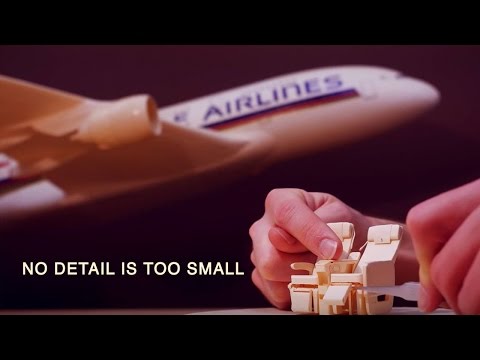
This playlist is a study in the strategic use of friction. While most brands rush toward the friction-less "render farm" aesthetic, Singapore Airlines: No Detail is Too Small went the opposite direction. Artist Luca Iaconi-Stewart spent "1,000 hours hand-cutting 3,000 individual pieces" of paper to build a plane interior. That level of obsession isn't just a production choice - it’s the strategy itself. It mirrors the airline's own claim of precision. You cannot fake that kind of commitment with a prompt. It’s the difference between a handwritten letter and a mass-printed flyer; the recipient feels the labor. This turns a product claim into a believable truth because the audience witnesses the physical price paid to tell it.
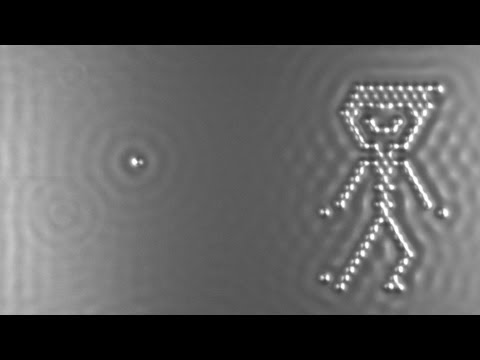
The tactile approach creates a "stop-and-stare" effect that digital gloss simply cannot replicate. In BritBox: See It Differently, the agency chose a "15-hour, single-take practical transformation" where an actor sat still while a 50-person crew swapped sets around her. This is a stunt of endurance that forces respect for the craftsmanship. Similarly, IBM: A Boy and his Atom moved carbon monoxide molecules at "minus 268 degrees Celsius" to prove a point about nanotechnology. These brands understand that in an era of infinite, cheap digital assets, the most valuable currency is evidence of human effort. We lean in when we see the thumbprints in Apple: Fuzzy Feelings or the "quantum mechanical probability waves" in an IBM lab because they feel undeniably, stubbornly real.
Beyond the technical flex, tactile craft allows for an emotional honesty that CGI often sanitizes. Bodyform: Womb Stories used "oil paint on glass" to depict the visceral reality of endometriosis, while Childline: Nobody is Normal used "ceramic" puppets to represent the rigid social masks we wear. Embracing the messy and the physically difficult bypasses our "skip" reflex. These campaigns don't look like commercials; they look like artifacts. They remind us that the most effective way to reach a human heart is through something a human actually touched. If your creative feels invisible, stop looking for a better algorithm and start looking for a more difficult way to build it.